|
|
Dear ,
This is your weekly summary of our news, research, books, videos, and other resources related to senior living, retirement, and care in Mexico, along with independent and assisted living and information about age-related challenges (e.g., limited mobility, dementia, Alzheimer's, Parkinson's, ALS, stroke, multiple sclerosis, healthspan, and so on).
I hope you are finding this weekly newsletter helpful, and if you know of someone who may also find this information helpful, please forward it to them. They can subscribe using our Web Newsletter page (click here). If, for any reason, you do not wish to receive this weekly newsletter any longer, there is a simple 'Unsubscribe' or 'Opt Out' link at the bottom right corner of this newsletter and also right here: Unsubscribe
This weekly newsletter typically includes information in each of the following categories: San Miguel insights, senior care, and health information, as well as Cielito Lindo basic information.
Here’s what we typically cover each week:
- San Miguel de Allende highlights – why this is such a special place to live
- Health & wellness insights – articles, videos, and expert reviews
- Care options & community life at Cielito Lindo – flexible, affordable living with a warm, human touch
This Week’s Theme: The Unacknowledged Caregiver
This week, we explore how we can tap into gratitude as one of our coping mechanisms.
|
|
|
|
|
| Weekly insights into San Miguel:
|
|
|
- Colorful and Epicurean San Miguel - This is such an amazing place,
particularly the food and the colors. Although we are addressing a topic that is stressful, challenging, and emotional, we should also acknowledge what an incredible place San Miguel is.
|
|
|
|
|
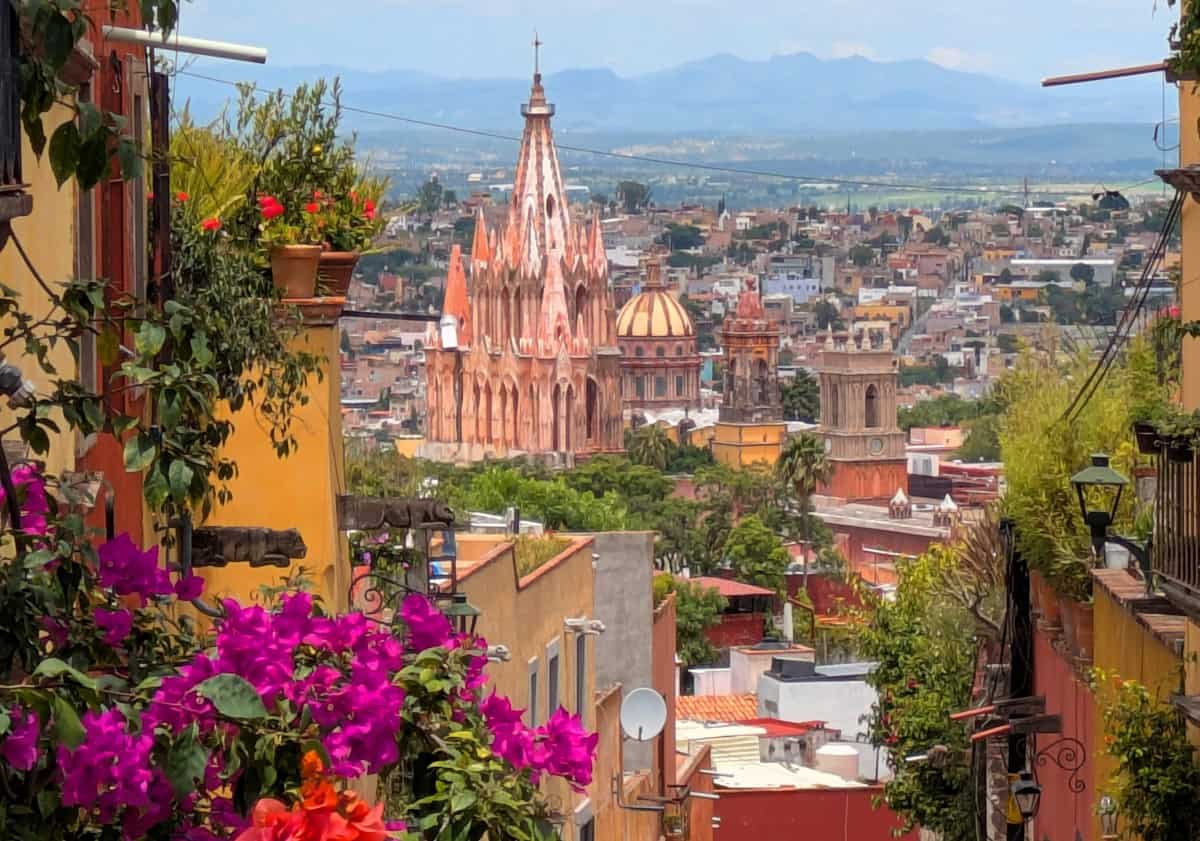
The Colors of San Miguel: Beauty in Every Direction
Even from a humble callejón like this one, where the bougainvillea spill like laughter over the walls and the ochre buildings press in with a kind of sun-warmed closeness, the city seems to arrange itself just so — the way friends might gather naturally around a table, everyone glowing in their own way. And then, like a secret revealed mid-conversation, there she is: La Parroquia de San Miguel Arcángel, rising like a storybook promise beyond the rooftops. Pink stone lit by a generous sun, framed by the distant blue hush of mountains.
What makes it more than picturesque is how alive it feels. There's the hum of life below — maybe someone rolling a cart of tamales, a soft trill of guitarra from a nearby window, the faint smell of tortillas on the comal. Even the air seems touched with a kind of quiet reverence, as if the city knows she's
being admired and yet remains gracious, unassuming.
It's not about finding the perfect spot — it's about noticing how beauty keeps offering itself here, again and again, whether you're looking for it or not.
|
|
|
|
|
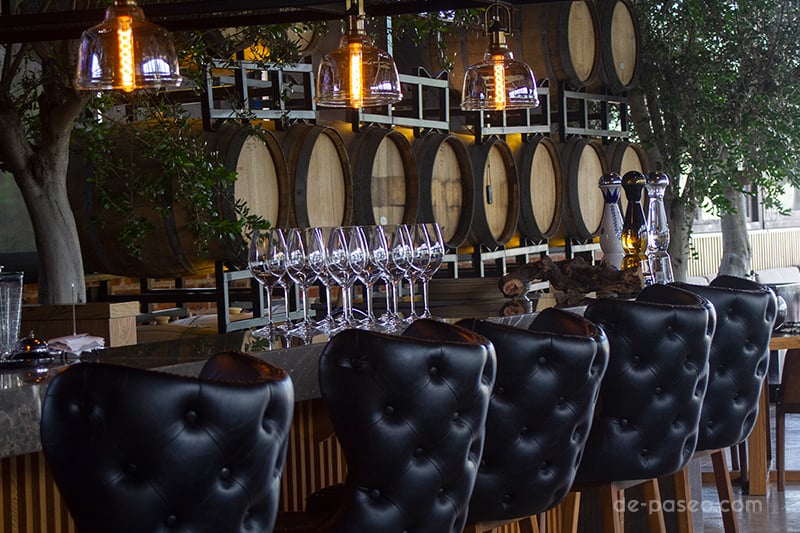
Tastes of San Miguel - Trasiego
Carretera Comonfort – San Miguel de Allende #1A KM 2, San Miguel de Allende, Guanajuato, Mexico. Phone: +52 477 274 4404. Days and Hours: Open Thursday–Saturday 2 PM – 10 PM and Sunday 1 PM – 8 PM. Closed Monday–Tuesday (and often Wednesday). Atmosphere: Trasiego is set within the scenic Viñedo San
Miguel vineyard, offering a rustic‑elegant ambiance with breathtaking vineyard views and a well‑designed terrace ideal for photos or relaxed conversation. Guests note the space is beautiful, welcoming, and perfect for family meals or romantic dinners. Service: Reviews frequently praise the attentive and knowledgeable staff, especially those versed in wine pairings, contributing to a refined but relaxed experience.
Cuisine: Contemporary Mexican cuisine with creative use of regional ingredients and techniques. There’s an emphasis on flavor innovation and thoughtful presentation, often paired with wines from the vineyard.
The Taco Ceremonial — a standout item crafted by chef David Quevedo (a tapas-competition winner) — is often recommended as a must‑try.
Guests enjoy inventive appetizers that complement both the chef’s creations and wine pairings. Seasonal and locally inspired small plates are frequently highlighted in reviews.
Main dishes blend traditional Mexican elements with contemporary flair — including expertly prepared meats (such as aged cuts) and well‑executed risottos — suited for sharing or savoring alongside a glass of the vineyard's wine.
Desserts receive mixed commentary — some praise the creativity, though a few visitors feel classics could be stronger — but many recommend sampling the house sweets, especially with wine.
The restaurant’s location in a vineyard makes wine a central part of the experience. A wide variety of estate wines (often recommended by staff) enhance the meal, and the cocktail list & mixology add a refined touch to the evening.
Final Thoughts: Trasiego offers a memorable culinary experience enhanced by its vineyard setting, attentive service, and creative contemporary Mexican fare. It’s ideal for food lovers who enjoy wine pairings and scenic dining — particularly for special meals or leisurely afternoons.
Cost: $$$$ (Upper‑midrange to fine dining pricing, often above MXN 500 per person) OpenTable Rating: ⭐⭐⭐⭐½ (generally around 4.6‑4.9/5 from diners)
|
|
|
|
|
| Information related to Mexico, senior care and health:
|
|
|
- Lead article - These are articles specifically written for you each week. They address a wide range of
relevant topics, such as factors that can increase your health and lifespan, diagnostics, understanding causal factors for Alzheimer's and other dementias, and so on. The lead article typically sets the tone for the core content of the newsletter (videos and book reviews). On occasion, the focus may be centered on Mexico, Pueblos Magicos, and San Miguel de Allende.
- Caregiver's Sentiment
- This quote typically honors what we, as caregivers, are going through and feeling.
- Caregiver's Affirmation - This affirmation bolsters our self care, our image or ourselves on this journey and our ability to endure.
- Videos - Typically, three videos are related to the lead article, and they include a summary and timestamped highlights.
- Book Review - Typically related to the lead article.
|
|
|
|
|
If one more person tells you to “just be grateful” while you’re juggling adult diapers, insurance claims, and emotional burnout, you might scream. For those in long-term caregiving roles—whether for aging parents, disabled partners, or chronically ill children—gratitude can sound like a naive suggestion, a soft whisper in the middle of a storm.
But what if I told you that gratitude isn’t just a
mindset? It’s a neurological intervention.
Gratitude as Biology, Not Just Philosophy
Gratitude is often painted as a lifestyle aesthetic—vision boards, sunset journals, softly lit affirmations. But strip away the fluff, and what remains is neuroscience.
Practicing gratitude activates the hypothalamic-pituitary-adrenal (HPA) axis—your body’s central
stress-response system. When you pause to sincerely reflect on something you’re thankful for, even for a moment, your brain releases a cascade of neurochemicals: cortisol levels drop, while dopamine and serotonin (your natural feel-good transmitters) rise. According to a 2016 study published in Psychosomatic Medicine, participants who wrote gratitude letters showed better mental health for weeks afterward—even if they never sent the letters.
This isn’t wishful thinking. It’s measurable. It’s chemical. And it’s fast.
A Minute to Reset
Caregiving doesn’t offer long, uninterrupted windows for mindfulness. The demands are constant, and self-care often feels like a punchline. But gratitude doesn’t require a silent retreat—it needs just a sliver of attention.
Neuroscientist Dr. Alex Korb explains that even briefly recalling something positive can nudge the brain into a more regulated state. A single minute of genuine gratitude—thinking about a warm smile, a shared memory, or a few quiet seconds of
peace—can shift your nervous system out of fight-or-flight.
It’s not magic. It’s biology. And for caregivers, that minute can be the difference between emotional survival and spiraling overwhelm.
Not Escapism—Emotional Endurance
There’s a misconception that gratitude is a kind of spiritual bypassing—that it glosses over grief, frustration, or despair. But real gratitude doesn’t cancel out hardship. It coexists with it.
In fact, the power of gratitude lies in its ability to create emotional contrast. It allows you to feel joy alongside fatigue, to access meaning without denying pain. That’s not weakness—it’s resilience. It’s precisely this emotional flexibility that helps caregivers keep going, not by pretending everything is okay, but by recognizing what still is.
The Objection: “Gratitude is a Luxury”
Some will argue that gratitude is a
privilege reserved for those with time, energy, or spiritual inclination. But the truth is often the opposite. It’s those in the trenches—those facing impossible choices, chronic exhaustion, and invisible grief—who need it most.
And they know how to find it. I’ve seen caregivers who, in the thick of heartbreak, still light up talking about a shared laugh or a moment of calm. These aren’t naive people. They’re neurologically savvy, whether they realize it or not. They’ve learned that noticing small pockets of good doesn’t diminish the weight of their work—it makes it bearable.
The Takeaway
Gratitude is not just a virtue. It’s a tool. A form of cognitive nutrition. A biochemical edge in a world that asks too much of too many.
If you’re a caregiver, you don’t need to be grateful instead of being overwhelmed, exhausted, or angry. You can be grateful and all of those things. Because gratitude, when practiced intentionally and authentically, doesn’t
demand denial. It offers support.
So the next time you feel like gratitude is too small for your storm, remember: it might be the only thing strong enough to carry you through it.
Offered with sincerity, compassion, and love.
You can access this article here and select others from our collection of 100+ articles on our site.
|
|
|
|
|
Caregiving is not sustained by strength alone. Over time, it taxes the nervous system, reshapes identity, and quietly erodes emotional and physical reserves. In that reality, gratitude is not a platitude or a mindset hack; it is a form of self-preservation. Practiced honestly, gratitude helps regulate the stress response, lowers cortisol, steadies the heart, and restores a sense of agency when circumstances cannot be changed. Psychologically, it anchors attention in what is still real and intact, protecting against despair and emotional exhaustion. Physiologically, it signals safety to the body, allowing breath, digestion, and rest to return, even briefly. For long-term
caregivers, gratitude becomes less about optimism and more about endurance, a way to stay present without breaking, to remain human in conditions that often feel unrelenting. This song lives in that space.
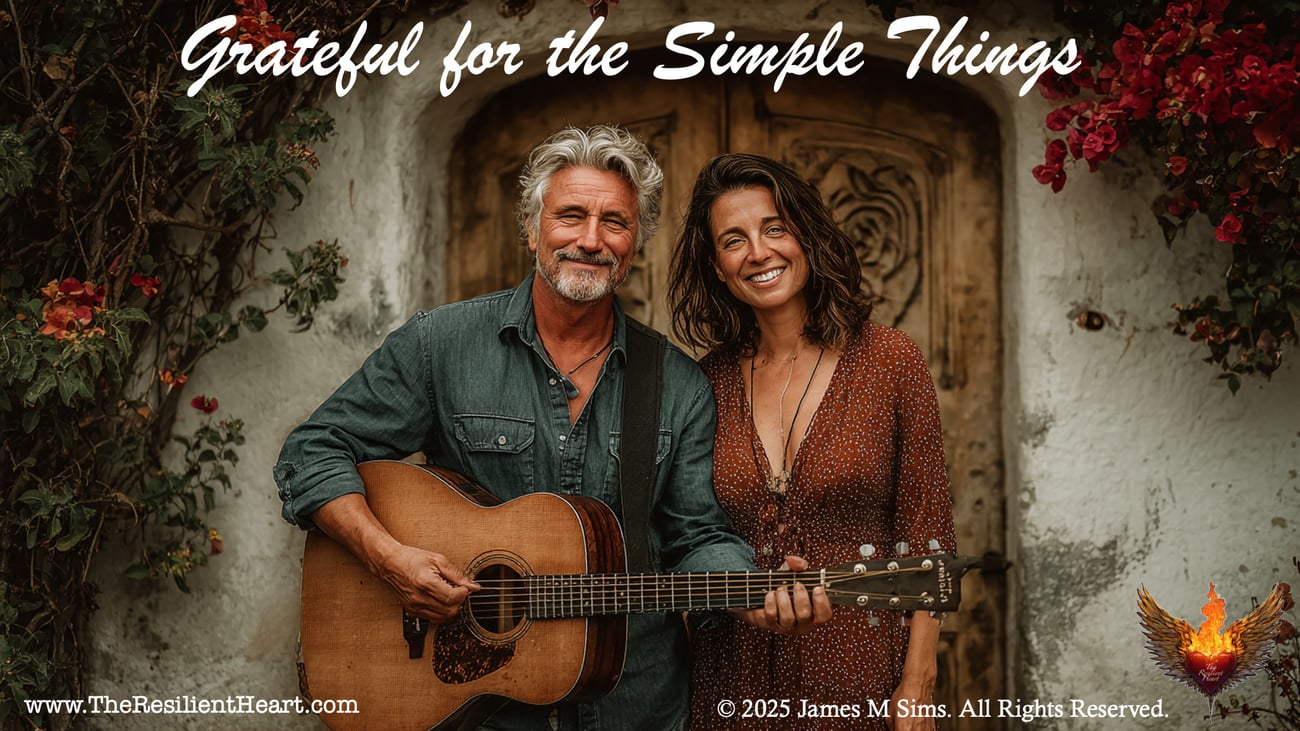
Song: Grateful for the Simple Things – A Folk Country Ballad on Caregiving, Gratitude & Quiet Strength
This heartfelt folk-country ballad honors the quiet courage of caregiving and the grace found in life’s simplest moments.
Grateful for the Simple Things is a love letter to the small, sacred moments that sustain us through long seasons of care — the soft light on the floor, a hand held in silence, the comfort of routine, a laugh at the end of a hard day.
Told through warm acoustic instrumentation and tender harmonies, this song captures the emotional landscape of endurance, love, and renewal. The verses linger in a reflective minor key, mirroring the weariness of long-term caregiving, while the choruses rise to express gratitude and quiet strength.
Inspired by artists like Alison Krauss and Union Station, this piece speaks to anyone who has walked the long road of care and come out deepened — discovering beauty not in what’s lost, but in what remains. Perfect for moments of reflection, healing playlists, or tributes to those who give their all in love.
This song was born from the quiet, often invisible world of long-term caregiving — the kind that stretches across years and wears down more than just the body. It speaks from the perspective of someone who has carried the weight of love expressed through responsibility, sacrifice, and endurance.
There was a point when nothing external could change. The situation didn’t improve. The suffering didn’t end. The only shift possible came from within — from the perspective I brought to each moment. That’s where this song lives.
“Grateful for the Simple Things” is about the small, sacred moments that became lifelines:
- The soft light on the floor
- A hand held in silence
- The comfort of routine
- A laugh at the end of a hard day
The hook — “I’m just grateful for the simple things” — isn’t resignation. It’s revelation. It’s the soul learning to breathe in what it still has, even when so much feels lost.
The phrase “a breath that holds” reflects that — a quiet, steady breath you take not to escape, but to stay present… to feel something without breaking.
Musically, I chose a folk/country ballad approach, inspired by artists like Alison Krauss and Union Station. The verses rest in a minor key, reflecting the weariness and sorrow of the caregiving journey. But the choruses lift into major — symbolizing the relief and strength found in gratitude. The acoustic instruments and vocal harmonies mirror the balance between vulnerability and quiet power.
This is a song for anyone who's walked the long road of care and come out not unchanged — but deepened. And more than anything, it’s a love letter to those everyday moments that, in the end, mean everything.
Listen to the song here.
Key: Verses in A minor → Chorus in
C major | BPM: 76 | Genre: Folk Ballad
Lyrics
Verse 1
The night shift ends, but the morning begins
Coffee in hand, bones aching again
No one sees the quiet wars I fight
With every pill, every whispered goodnight
Pre-Chorus
I used to pray for change that never came
'Til I found a softer way to frame the pain
Chorus
I’m just grateful for the simple things
Like the sun on the floor and the song the kettle sings
A breath that holds, a moment that stays
A laugh in the dark at the end of hard days
I can’t change the weight that caring brings
But I’m just grateful for the simple things
Verse 2
The TV hums low, her hand in mine
Time moves slow, but love realigns
I used to count all the things I had lost
Now I count raindrops and never mind the cost
Pre-Chorus
There’s beauty in the worn and the routine
In folded towels and rooms kept clean
Chorus
I’m just grateful for the simple things
Like the wind in the trees and the quiet that peace brings
A breath that holds, a moment that stays
A smile through the tears at the end of hard days
I can’t change the weight that caring brings
But I’m just grateful for the simple things
Bridge
Maybe joy’s not made of thunder or gold
Maybe it’s soft, maybe it’s old
Maybe it’s learning to let go...
Final Chorus
I’m just grateful for the simple things
Like a cool morning breeze and the hush that silence brings
A breath that holds, a moment that stays
A heart that forgives, come what may
I can’t change the weight that caring brings
But I’m just grateful for the simple things
Outro
I’m just grateful… for the simple things
Copyright: Lyrics, music, arrangement, and production © 2025 James M Sims. All Rights Reserved.
About James M Sims
James brings nearly five decades of professional experience as a technology and strategy executive in industries including food and beverage manufacturing, grocery retail and distribution, worldwide augmentative staffing, heavy construction, home building, structural engineering, transportation, and healthcare. His creative pursuits have been equally diverse, spanning a career as a black-and-white fine art photographer, furniture designer and builder, custom Stratocaster guitar craftsman, culinary content creator, and digital marketing professional.
Following a 14-year journey caring for his late wife, who lived with early-onset Alzheimer’s, James discovered his purpose for this stage of life as a senior care advocate and journalist. His mission is to create meaningful content for
caregivers and their families—through long-form and op-ed articles, photography, videos, and songs—offering insight, support, and a voice for those navigating the challenges of care.
Cielito Lindo, situated within Rancho Los Labradores, is a warm, integrated senior-living community in the heart of San Miguel de Allende, Mexico. Offering full-spectrum care — from independent living to memory care and hospice — it blends heartfelt hospitality with beautiful grounds, colonial-style architecture, and compassionate, practical services tailored to each resident’s needs.
Rancho Los Labradores is a master-planned, gated retirement haven known for its elegant villas, lush gardens, mountain views, and a vibrant yet serene pace of life. Together, they create a setting where comfort, community, and quality of life flourish in every season.
James Sims
📧 James@CielitoLindoSeniorLiving.com
📞 1.888.406.7990
The Resilient Heart
Albums on YouTube:
• Taking Care
• The Long Goodbye
• Love and Renewal
• Bienvenidos
Official Website: The Resilient Heart
Streaming on 23+ platforms, including:
• Spotify
• Apple Music
• Amazon Music
• YouTube Music
• Tidal
• Deezer
• iHeartRadio
|
|
|
|
|
Song: Gratitude Didn’t Come Easy – A Caregiver’s Folk Ballad on Loss, Love & Alzheimer’s
This intimate folk ballad traces how gratitude is painfully, beautifully forged through caregiving, Alzheimer’s, and the long road of loss and remembrance.
“Gratitude Didn’t Come Easy” is a soul-bearing contemporary folk ballad about discovering grace in the darkest seasons of life. Inspired by real caregiving experiences—early-onset Alzheimer’s, long-term decline, and the quiet work of loving someone who no longer remembers—the song follows a journey from grief and confusion to presence, humility, and purpose.
Set in D minor with an intimate, bittersweet tone, the track blends acoustic storytelling, gentle melodic lines, and emotional folk textures. Through vivid scenes of caregiving, memory slipping away, and rediscovered meaning, the narrator reveals how gratitude becomes an act of resilience rather than a simple feeling.
Perfect for caregivers, memory-care communities, grief support groups, elder-care advocates, and anyone who has walked beside a loved one through decline. This video also supports awareness for compassionate senior-living environments like Rancho Los Labradores and Cielito Lindo in San Miguel de Allende, Mexico.
Genre: Contemporary Folk Ballad | Key: D minor | Mood: Intimate, bittersweet | BPM: 84
Lyrics
[Verse 1]
I used to think that gratitude
Was something sweet and small
A grace you said at dinnertime
Or after a windfall
It lived in good news, holidays
And laughter over wine
But never showed its face to me
When I was out of time
[Verse 2]
My father died too young to teach
What grief would make me see
And when she slipped away from me
Each year, more silently
Fourteen falls, and winter stayed
The years did not rewind
But I learned to sit in silence
And thank what pain would find
[Chorus]
Gratitude didn’t come easy
It never came wrapped in light
It crept in through the cracks of loss
And held me through the night
It’s not some fleeting feeling
It’s the only way to be
When loving means remembering
Someone who can't remember me
[Verse 3]
I fed her soup with quiet hands
She smiled, forgot my name
But still I saw a shimmer there
No illness could explain
Each nod, each breath, each trembling laugh
A moment to reclaim
And in that slow unraveling
Gratitude finally came
[Bridge]
Now I spend my days with others
Who walk the same worn track
We carry love in paper skin
And never ask for it back
It’s not a job, it’s not a choreIt’s not a job, it’s not a chore
It’s what I’m meant to doIt’s what I’m meant to do
To show them they are not alone—To show them they are not alone—
Like she once showed me tooLike she once showed me too
[Final Chorus][Final Chorus]
Gratitude didn’t come easyGratitude didn’t come easy
But now it comes each dayBut now it comes each day
In every hand I get to holdIn every hand I get to hold
And every word I sayAnd every word I say
It’s not about the sunlightIt’s not about the sunlight
It’s what you choose to seeIt’s what you choose to see
It’s not a prize, it’s how I liveIt’s not a prize, it’s how I live
Since grief gave sight to meSince grief gave sight to me
Copyright: Lyrics, music, arrangement, and production © 2025 James M Sims. All Rights Reserved.Copyright: Lyrics, music, arrangement, and production © 2025 James M Sims. All Rights Reserved.
About James M Sims
James brings nearly five decades of professional experience as a technology and strategy executive in industries including food and beverage manufacturing, grocery retail and distribution, worldwide augmentative staffing, heavy construction, home building, structural engineering, transportation, and healthcare. His creative pursuits have been equally diverse, spanning a career as a black-and-white fine art photographer, furniture designer and builder, custom Stratocaster guitar craftsman, culinary content creator, and digital marketing professional.
Following a 14-year journey caring for his late wife, who lived with early-onset Alzheimer’s, James discovered his purpose for this stage of life as a senior care advocate and journalist. His mission is to create meaningful content for caregivers and their families—through long-form and op-ed articles, photography, videos, and songs—offering insight, support, and a voice for those navigating the challenges of care.
Cielito Lindo, situated within Rancho Los Labradores, is a warm, integrated senior-living community in the heart of San Miguel de Allende, Mexico. Offering full-spectrum care — from independent living to memory care and hospice — it blends heartfelt hospitality with beautiful grounds, colonial-style architecture, and compassionate, practical services tailored to each
resident’s needs.
Rancho Los Labradores is a master-planned, gated retirement haven known for its elegant villas, lush gardens, mountain views, and a vibrant yet serene pace of life. Together, they create a setting where comfort, community, and quality of life flourish in every season.
James Sims
📧 James@CielitoLindoSeniorLiving.com
📞 1.888.406.7990
The Resilient Heart
Albums on YouTube:
• Taking Care
• The Long Goodbye
• Love and Renewal
• Bienvenidos
Official Website: The Resilient Heart
Streaming on 23+ platforms, including:
• Spotify
• Apple Music
• Amazon Music
• YouTube Music
• Tidal
• Deezer
• iHeartRadio
|
|
|
|
|
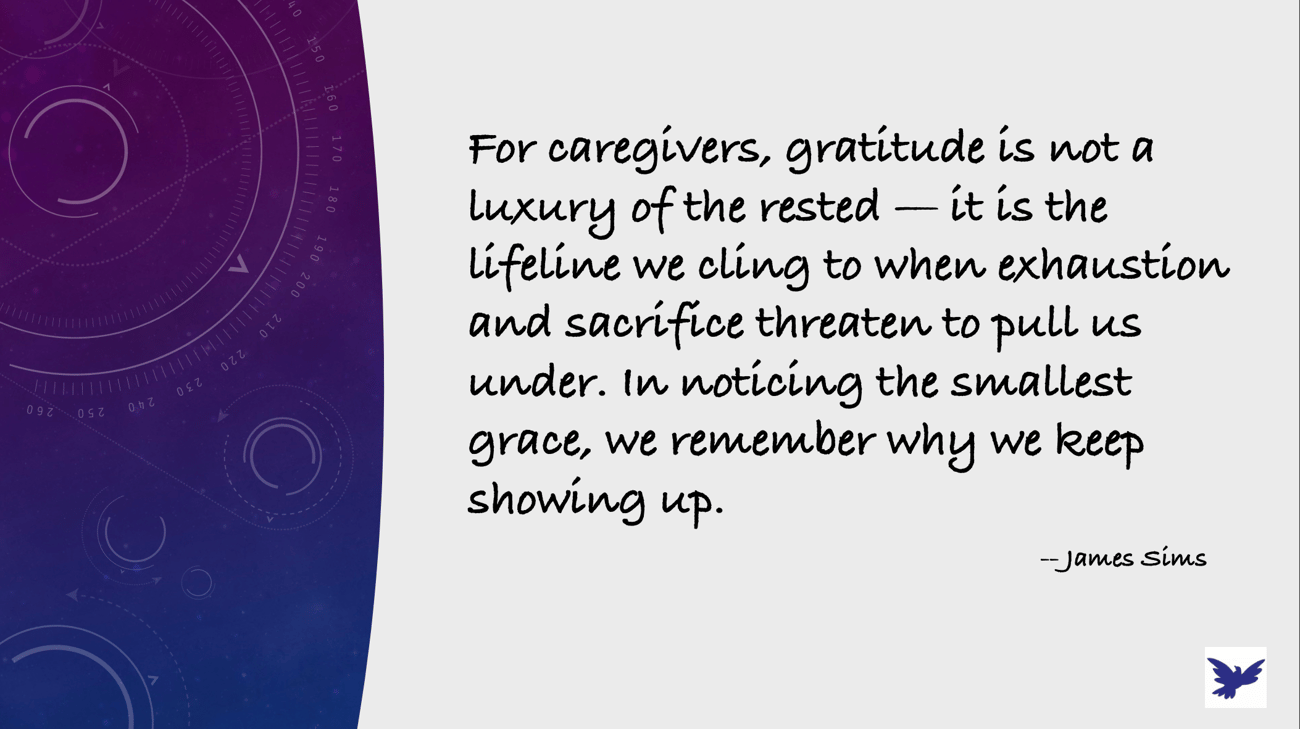
Caregiver's Sentiment: Gratitude is Not a Luxury
This quote honors the emotional and physical toll caregiving often exacts, reframing gratitude not as something indulgent or optional, but as essential. For those constantly giving, often invisibly, gratitude becomes a quiet act of resilience — a way to anchor oneself when there's little left in reserve. It’s not about pretending things are easy; it’s about surviving with your soul intact by holding onto glimpses of meaning and kindness. Whether it's a smile from the person you care for, a brief moment of peace, or a kind word from someone who recognizes your effort, gratitude helps caregivers not only endure but also remember that what they do matters — and so do they.
|
|
|
|
|
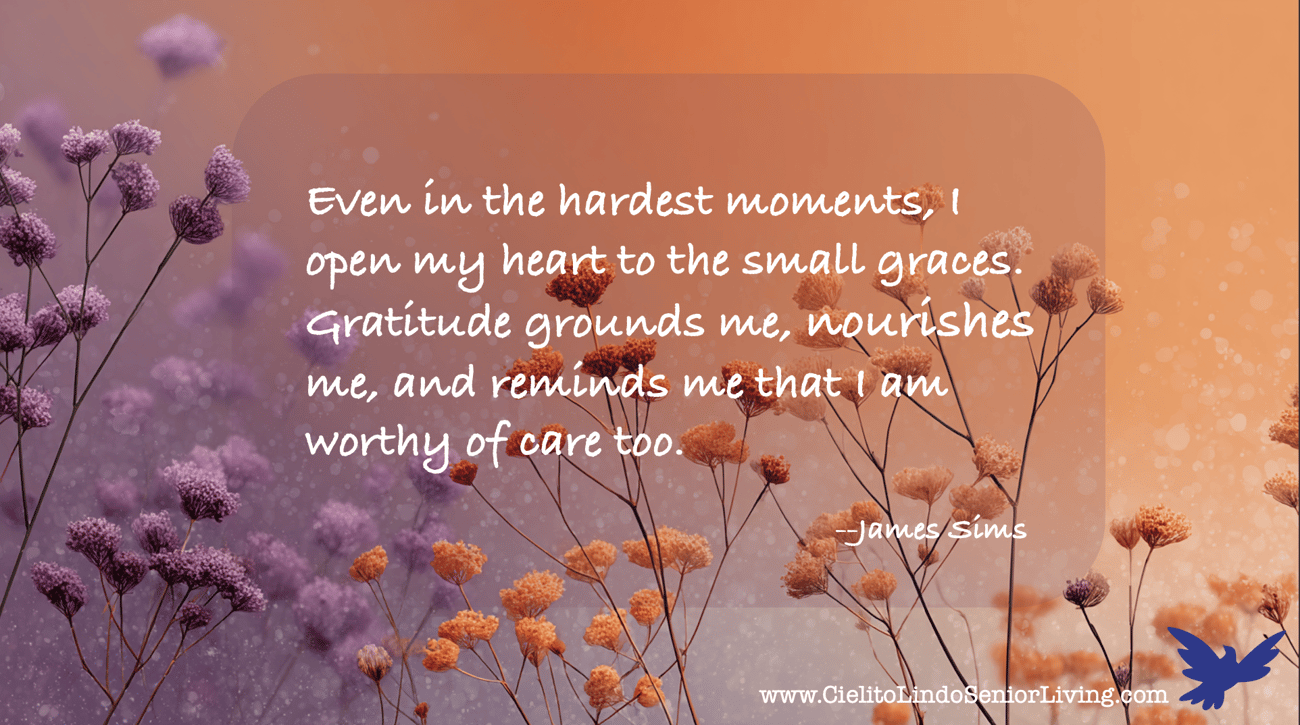
Caregiver Affirmation
This affirmation gently reinforces the idea that gratitude is a sustaining force, not a demand to be cheerful — and importantly, it acknowledges the caregiver’s own need for care and compassion. It invites a moment of inward kindness, encouraging the caregiver to pause and reconnect with themselves, not just their duties.
|
|
|
|
|
Video: When caregiving comes
your way: Pamela Nelson at TEDxSMU 2013
Pamela Nelson’s TEDx talk offers a warm, generous glimpse into the world of caregiving. Her reflections on humor, resilience, partnership, and the quiet strength that emerges when life changes direction will resonate with many who have walked this path. Her story is uplifting, rooted in mutuality, and carried by moments of connection that remain intact even as illness reshapes daily life.
For those caring for someone with a chronic disease marked by progressive cognitive loss, the journey often unfolds differently. Mutuality becomes harder to maintain. Shared decision-making, shared
jokes, shared rituals, and even shared memories may slowly slip out of reach. The emotional center of gravity shifts. Caregiving becomes less of a partnership and more of a one-way act of devotion; not because the love is diminished, but because the person you love is losing capacities they never wanted to
surrender.
None of this diminishes the value of Pamela’s message. In fact, it highlights why her reminders—to laugh when you can, to accept help, to forgive misunderstandings, to pause, to stay present—matter so deeply. For some of us, these practices become not just helpful suggestions but the lifelines that carry
us through the long, uneven terrain of cognitive decline.
Her talk serves as a beautiful entry point into the conversation, and I continue to admire it. At the same time, I want to honor the different emotional contours that come with conditions like Alzheimer’s, Parkinson’s, PSP, frontotemporal dementia, and other disorders that steadily erode cognition. The caregiving experience in these cases is often marked by ambiguity, anticipatory grief, and the slow unraveling of shared identity. Finding a mutually happy middle ground becomes more challenging as the illness advances, and yet many caregivers continue to show up with
extraordinary patience and quiet courage.
With that context in mind, this video is still worth every minute—not because it mirrors every caregiving experience, but because it reminds us why love keeps us in the room, long after circumstances have changed.
View the video here:
Highlights:
0:02 - Pamela introduces herself as an artist who has prioritized her art for decades.
1:10 - She reflects on a quote by Virginia Woolf about arranging the pieces that come your
way.
2:06 - Pamela recounts the day of September 11, 2001, and her husband's routine surgery.
3:11 - She shares her husband's diagnosis of progressive supranuclear palsy (PSP) and its impact on their lives.
5:44 - Bill's resilience and humor shine through despite his illness, teaching valuable life lessons.
6:35 - Pamela offers tips for caregivers, emphasizing the importance of laughter and support.
8:10 - She discusses the significance of taking moments to pause and reflect amidst caregiving challenges.
9:03 - Pamela stresses the need to forgive those who may not understand the struggles of caregiving.
10:14 - She
highlights the deep intimacy and connection developed through shared experiences in caregiving.
11:45 - The couple's nightly ritual of reviewing their day and sharing highlights before sleep.
|
|
|
|
|
Critical Brain Health Factors
For those of us who have cared for someone living with cognitive
decline, the experience reshapes more than our daily routines; it alters the way we think about our own future. Bearing witness to the slow, heartbreaking erosion of memory, personality, and independence naturally turns our attention inward. We begin to wonder what is happening inside our own brains. We hope, sometimes quietly and sometimes with real fear, that we will not face the same fate. That hope often sends us searching for answers, for something that can help us understand what protects the brain, what strengthens it, and what gives us a measure of agency in the midst of so much uncertainty.
That is why Dr. Lara Boyd’s TEDx talk is so meaningful. Her explanation of neuroplasticity—the brain’s ability to change, adapt, and reorganize throughout our entire
lives—offers more than scientific insight. It offers encouragement. She reminds us that the brain is not fixed or predetermined, that it responds to how we live, what we practice, and the choices we make each day. For caregivers, and for anyone living with the shadow of cognitive loss, this knowledge can feel like a lifeline. It reframes the conversation from inevitability to possibility, from fear to informed hope.Dr. Boyd’s research shows that meaningful change is driven not by age or luck, but by engagement, repetition, and sustained effort. Understanding this does not erase the grief of watching someone decline, but it does remind us that our
own brains remain responsive and capable. This video is a powerful starting point for anyone seeking to better understand how learning, habit, and intention can shape the health of the mind.
Video: After watching this, your brain will not be the same | Lara Boyd | TEDxVancouver
In her TEDx talk, Dr. Lara Boyd explores the dynamic nature of the brain and how learning reshapes it through neuroplasticity. She dispels common myths, such as the belief that the brain stops changing after childhood, and
emphasizes that the brain remains active even at rest. Boyd explains that learning induces chemical, structural, and functional changes in the brain, which are essential for both short-term and long-term memory. She provides examples of how specialized skills can lead to physical changes in brain regions. Ultimately, she questions the factors that limit neuroplasticity, particularly in the context of learning difficulties and recovery from brain injuries.In her talk, Dr. Boyd emphasizes the importance of understanding neuroplasticity and its implications for learning and recovery. She advocates for personalized approaches in both medicine and education, recognizing that individual differences significantly affect outcomes. The key takeaway is that active engagement and
practice are vital for brain development, and individuals should be mindful of their behaviors to foster positive changes in their brains.
View the video here.
Highlights:0:14 - Dr. Lara Boyd introduces her
fascination with how we learn and the differences in learning abilities.1:03 - The misconception that the brain does not change after childhood is debunked.1:27 - The brain is highly active even when at rest, contrary to previous beliefs.1:49 - Neuroplasticity is introduced as the concept that learning changes the brain.2:41 - The brain changes chemically to support learning through increased signaling between neurons.3:18 - Structural changes in the brain occur during learning, affecting long-term memory.4:02 - Short-term improvements in skills may not reflect actual learning due to the need for
structural changes.4:49 - Examples of brain structure changes in individuals with specialized skills, like Braille readers and taxi drivers.5:20 - Functional changes in the brain occur as regions become more excitable with use.6:08 - Dr. Boyd raises questions about the limitations of neuroplasticity and its implications for learning and recovery.6:53 - Stroke recovery is challenging, and effective rehabilitation interventions are lacking.7:41 - Behavior is the primary driver of neuroplastic change in the brain.8:05 - Research focuses on therapies that prepare the brain to learn, including brain stimulation and exercise.9:11 - There is no neuroplasticity drug; practice is essential
for learning.10:14 - There is no one-size-fits-all approach to learning; personalized medicine is crucial.11:20 - Biomarkers can help match therapies with individual patients for better recovery outcomes.12:03 - Personalized learning is important as each brain is unique.12:40 - Understanding individual patterns of change can advance neuroscience and interventions.13:00 - Learning strategies will vary between individuals and even within the same person.14:10 - Everything you do shapes your brain; aim to build the brain you want.
|
|
|
|
|
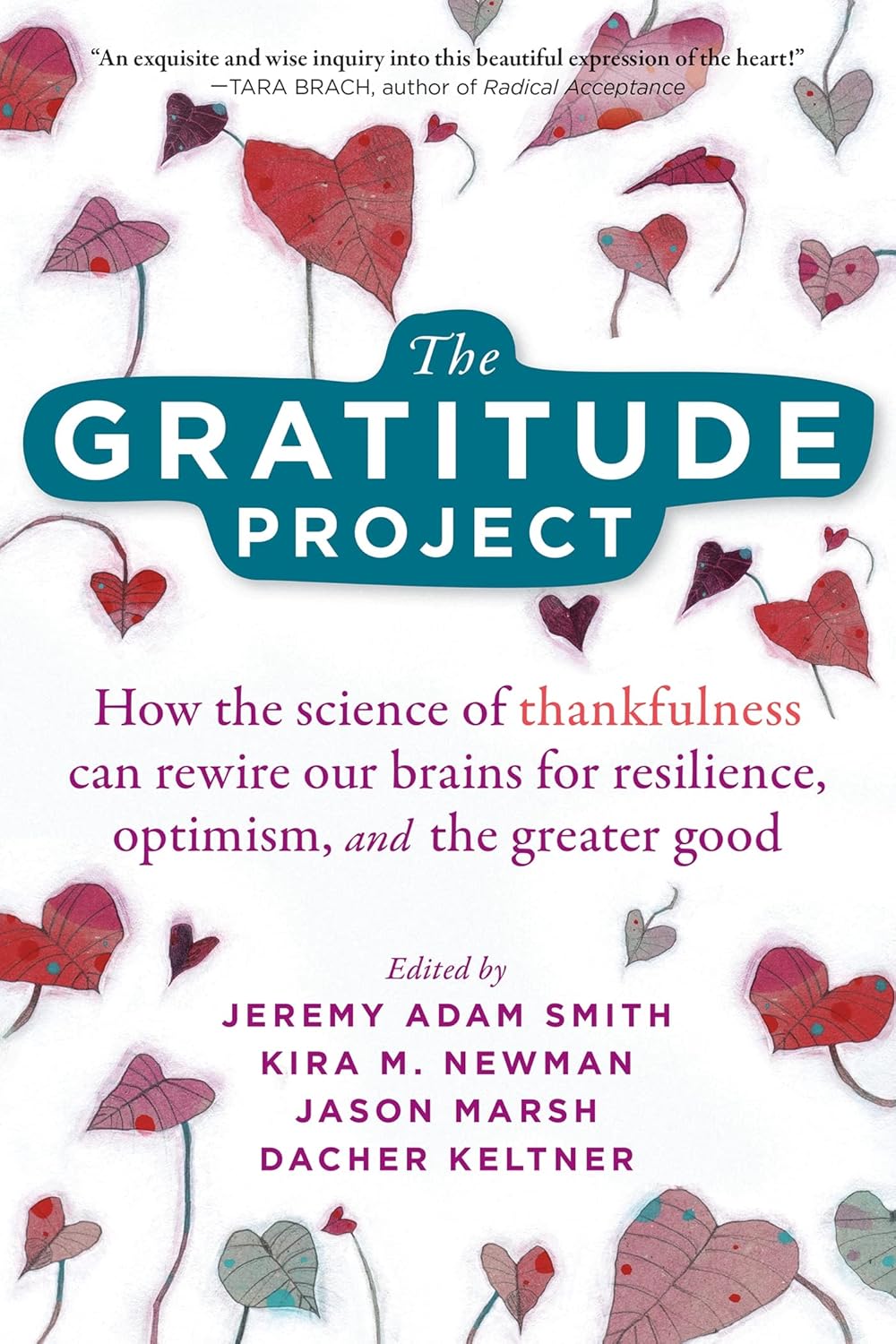
The Gratitude Project: How the Science of Thankfulness Can Rewire Our Brains for Resilience, Optimism, and the Greater Good Edited by Jeremy Adam Smith, Kira M. Newman, Jason Marsh, and Dacher Keltner
Overview
The Gratitude Project is a well-researched, science-based exploration of how gratitude can be a transformative force for individuals and society. Created through a collaboration between the Greater Good Science Center and Robert Emmons—one of the foremost researchers on gratitude—the book
compiles essays from leading psychologists, public figures, and thought leaders. It presents a strong case for gratitude not just as a virtue but as a practice that improves emotional, psychological, and even physical well-being.
This volume is particularly compelling for older readers, caregivers, and those navigating life transitions such as retirement or relocation, as it offers practical tools for cultivating positivity, resilience, and deeper social connection.
Synopsis
The book is a collection of essays structured around the science and application of gratitude. It begins by examining the evolutionary and neurological underpinnings of
thankfulness and progresses to explore how gratitude can be cultivated and practiced in everyday life.
Contributors include well-known figures such as Sonja Lyubomirsky and Arianna Huffington, who offer personal insights alongside psychological research. The essays delve into how gratitude can shape interpersonal relationships, bolster resilience in the face of adversity, and inspire prosocial behavior. Each chapter builds on the idea that gratitude is not just a fleeting feeling but a mindset and habit that can lead to long-term happiness and community well-being.
Key Themes
- Neuroscience of Gratitude: How gratitude changes brain activity and fosters positive mental health.
- Social Connection and Community: Gratitude strengthens relationships and promotes civic and communal engagement.
- Resilience and Mental Health: Practicing gratitude helps individuals cope with stress, loss, and life’s challenges.
- Cultural and Societal Impact: Thankfulness can serve as an antidote to division and individualism in modern society.
- Practical Tools: Journaling, mindful reflection, and gratitude rituals are presented as effective strategies for incorporating gratitude into daily life.
Writing Style
As an edited volume, the writing style varies slightly between chapters but maintains an accessible, engaging, and informative tone throughout. The editors have done an excellent job curating essays that blend scientific insight with storytelling. The language is approachable for general audiences, including seniors and caregivers who may be new to the science of positive psychology, but still looking for practical tools to enhance their quality of life.
While some readers may find the tone a bit academic in places, the mix of personal essays and case studies keeps the material grounded and relatable.
Conclusion
The Gratitude Project is a powerful and timely resource for anyone looking to improve well-being—personally and socially—through the intentional practice of gratitude. For seniors and those in caregiving roles, the book offers especially relevant insights into building emotional strength, nurturing relationships, and finding meaning in later life. The science-based approach distinguishes it from more anecdotal self-help books, making it a credible and practical guide.
It’s not just about “feeling thankful”—it’s about understanding how gratitude works and why it matters, especially in a
world that can feel increasingly disconnected.
Rating: ★★★★☆ (4.2 out of 5 stars)
A well-rounded, evidence-based collection that effectively translates science into practice. Highly recommended for older adults, caregivers, and community leaders looking for sustainable ways to cultivate well-being and social cohesion. A star is deducted for some unevenness in tone between chapters, but overall, it is an enlightening and uplifting read.
Additional Resources Cielito Lindo Offers
We have curated collections of resources that may be useful.
Articles - We write fresh articles about senior living, health, care, and
finances every week
Caregiver Books - We review books related to caregiving methods, logistics,
challenges, and coping
Senior Health - We review books related to healthspan, lifespan, and disease
We also have 1,700+ other senior care and expat in Mexico videos: YouTube
|
|
|
|
|
| Cielito Lindo's basic information is included for your convenience:
|
|
|
- Cielito Lindo Info: After the signature, the newsletter always includes information about Cielito Lindo, so it is at your fingertips when you want it: Our costs, various related websites, social media channels like YouTube, our various addresses, and so on.
- Travel Info: Recommended airports and shuttles.
|
|
|
Web Sites - Cielito LIndo and Rancho Los Labradores
Here are our Web sites, including Cielito Lindo and Labradores Suites (hotel) all of which are part of the larger Rancho Los Labradores gated community just north of San Miguel de Allende.
Web Sites - Cielito LIndo and Rancho Los Labradores
Here are our Web sites, including Cielito Lindo and Labradores Suites (hotel) all of which are part of the larger Rancho Los Labradores gated community just north of San Miguel de Allende.
- Cielito Lindo provides independent living, light assisted living, assisted living, memory care and hospice with 24*7 staffing along with a la carte assisted living services to those living in the villas and suites at Rancho Los Labradores.
- Rancho Los Labradores Suites offer short and long term residence.
- Rancho Los Labradores is a country club resort feeling CCRC that provides a gated community with countless amenities and opportunities for different levels of independent living along with assisted living and memory care within Cielito Lindo.
Cielito Lindo Living Options & Costs Guide
We offer several living options depending on the level
of care you or your loved one needs. Here’s a breakdown to help you plan:
1) Villas (Rent or Own)
- Cost: $1,300 – $1,700 per month
- Additional Costs: Utilities, renter’s insurance, etc.
- What’s Included: This is mostly independent living.
- Extras: You can add independent or assisted living services (charged separately, à la carte).
- Support: We can connect you with a realtor if you'd like to purchase.
2) Cielito Lindo Condos & Suites
Best for: Independent living with optional assistance.
Option 1: Independent Living + Meals
- Cost: $2,250 per month
Includes:- 2 meals a day
- Hotel like room cleaning, towel and linen service
- Monthly medical check-up
Optional Add-ons:- Meals for an additional person: $450/month
- Extra care services available à la carte
Option 2: Light-Assisted Living in Condos & Suites
- Cost: $3,900 per month
Includes:- Full assisted living services
- Designed for residents who still want independence but need some support
- Smooth transition to full Assisted Living or Memory Care as needs change
- One-Time Inscription Fee: $4,000
For Couples:- $4,900/month for two people
- Same one-time fee ($4,000 per couple)
- Note: Suitability is based on cognitive ability, mobility, and safety.
3) Cielito Lindo Assisted Living, Memory Care, & Hospice
Best for: Seniors needing full-time care and supervision.
- Cost: $3,900 per month
Includes:- 24/7 care and monitoring
- All meals
- Physical therapy
- Full-time doctor on site
- Spacious private room with
bath
- One-Time Inscription Fee: $4,000
- For
Couples: $4,900/month
4) Specialized Hospice Suite
Best for: Intensive care needs or end-of-life comfort and also recuperative at a far lower cost than a hospital- Cost: $4,900 per month
Includes:- Full 24/7 monitoring
- Recuperative, Palliative and hospice care
- On-site doctor
- All meals
- Special space for visiting family
|
|
|
YouTube videos and Curated Playlists
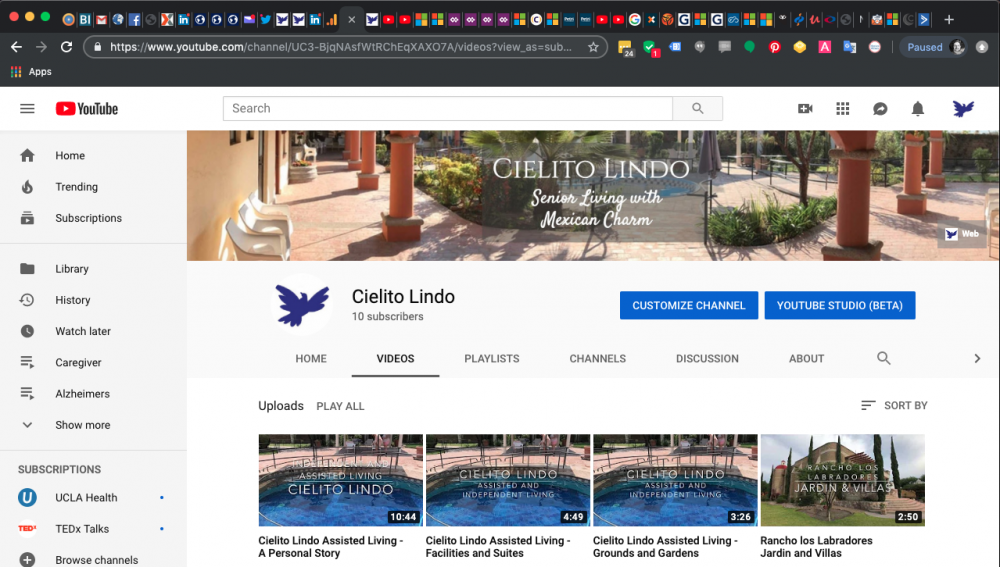
Here is our YouTube Channel. This is where we have lots of videos about Cielito Lindo and Rancho Los Labradores. We also have 1,600+ other senior care and expat in Mexico videos: YouTube |
|
|
|
|
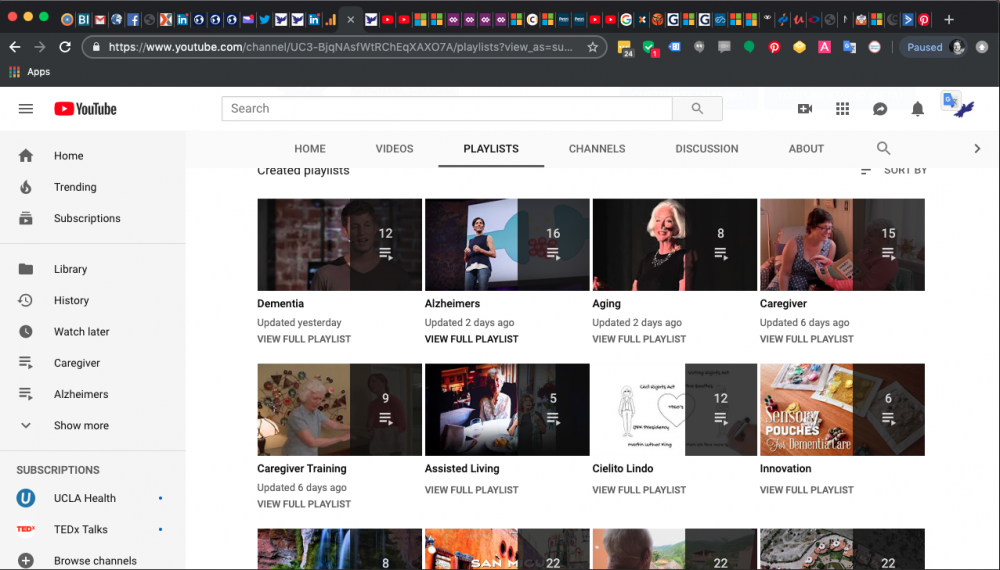
Additionally, our playlists cover a wide area and include 1,200+ videos. These playlists include videos about San Miguel and Mexico in general, caregiving and health, and a broad spectrum of senior living topics. Playlists
|
|
|
|
|
Additional Resources We Offer
We have curated collections of resources that may be useful:
Articles - We write fresh articles about senior living, health, care, and finances every week
Caregiver
Books - We review books related to caregiving methods, logistics, challenges, and coping
Senior Health - We review books related to healthspan, lifespan, and disease
And here are our various social media forums, where we talk a lot about assisted living and memory care along with the various sort of challenges that sometimes come in our senior years (Alzheimer’s, Parkinson other dementias, and so on), but also about senior living in Mexico.
Facebook
|
|
|
|
|
|
|
|
|
|
|
|
|
|
|
|
|
|
|
Please don’t hesitate to contact me for anything related to senior living, especially in Mexico. I will gladly give you any assistance I can.
Thanks again!
James
James Sims
Marketing and Sales
Cielito Lindo Senior Living
1. 888.406.7990 (Voice and text)
1.209.312.0555 (WhatsApp)
Phones:
English speaking:
1.888.406.7990 (in US & CDN)
00.1.881.406.7990 (in MX)
Spanish speaking:
011.52.415.101.0201 (in US & CDN)
1.415.101.0201 (in MX)
Expat Health
Insurance:
ExpatInsurance.com
Tax Considerations for Expats:
Robert Hall Taxes
Medicare in Mexico
Lakeside Medical Group:
Robert Ash - ash@lakemedical
Best Bank:
Intercam Banco
Located in: Plaza De La Conspiración
Address: San Francisco 4, Zona Centro,
37700 San Miguel de Allende, Gto., Mexico
Hours: Open ⋅ Closes 4 PM
Phone: +011 52 415 154 6660
Addresses and Travel:
Physical address:
Cielito Lindo Independent and Assisted Living, Camino Real Los Labradores S/N, Rancho Viejo 1, San Miguel de Allende, GTO, Mexico, 37885
Packages from online providers like Amazon:
Camino Real Los Labradores, Rancho Los Labradores / Cielito Lindo, San Miguel de Allende, GTO, 37880 México
PO Box for letters and small envelopes:
Rancho Los Labradores / Cielito Lindo, c/o Alejandra Serrano , PMB N° 515-C,
220 N Zapata HWY N°11, Laredo TX, 78043-4464
Air:
Best airports to fly into: Leon (BJX) or Queretaro (QRO)
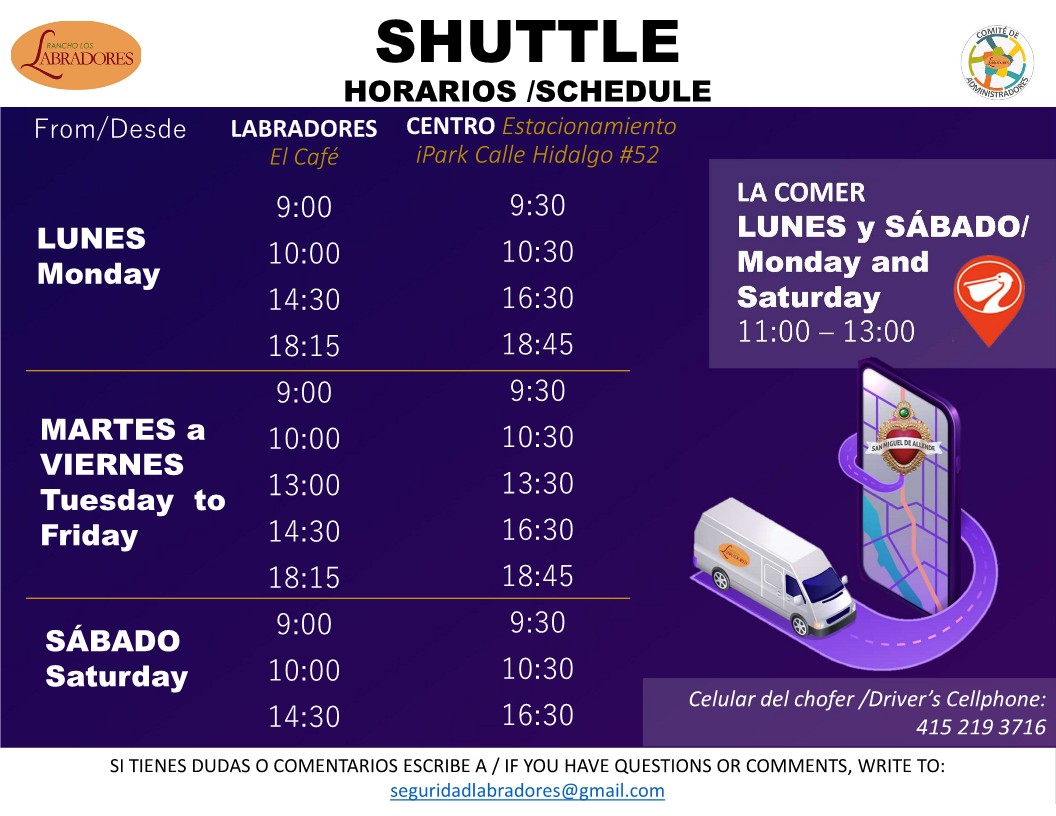
Shuttle:
Best
airport shuttle: BajioGo
Shuttle between San Miguel and Rancho Los Labradores / Cielito Lindo
|
|
|
|
|
|
|
Regards,
James
James Sims
Marketing and Sales
Cielto LIndo Senior Living
jsims.cielitolindo@gmail.com
|
|
|
|
|
|
|
|