|
|
Subject:
Your Weekly Guide to Senior Living & Care in Mexico
Dear ,
Welcome to your weekly touchpoint from all of us at Cielito Lindo. Each edition brings together helpful insights, heartwarming stories, expert advice, and curated resources about senior living, retirement, and age-related care challenges—including Alzheimer’s, Parkinson’s, stroke, limited mobility, and more.
We understand that navigating this stage of life can be overwhelming, whether for yourself or a loved one. That’s why we're here—to offer guidance, support, and a glimpse into the enriching life many have found
here in beautiful San Miguel de Allende.
If you find this newsletter valuable, please forward it to a friend or family member who might also benefit. They can easily subscribe via our Newsletter page. And of course, if you ever wish to unsubscribe, there’s a quick opt-out link below at the bottom right corner of this newsletter.
Here’s what we typically cover each week:
- San
Miguel de Allende highlights – why this is such a special place to live
- Health & wellness insights – articles, videos, and expert reviews
- Care options & community life at Cielito Lindo – flexible, affordable living with a warm, human touch
This Week’s Theme: Tailoring Digital Medicine for Our Elders
This week, we examine how telemedicine, medical apps, and healthcare provider websites can be better tailored to meet the needs and capabilities of our elders.
|
|
|
|
|
| Weekly insights into San Miguel:
|
|
|
Colorful & Epicurean San Miguel
While much of what we discuss involves the challenges of aging
and caregiving, it's also important to celebrate the beauty that surrounds us. San Miguel de Allende is a feast for the senses—bursting with color, rich in culture, and renowned for its incredible food and art. It’s not just a place to live—it’s a place to thrive, to enjoy, and to heal.
|
|
|
|
|
The Colors of San Miguel: I Adore This City
I have never seen a street view in San Miguel de Allende that didn’t steal a little breath from my lungs. Every callejón, every sloping cobblestone descent like the one in this
image, feels like it’s been held in a painter’s hand—washed in the kind of colors that seem to deepen with memory. The walls pulse with terracotta, mustard, and clay-red hues, not just painted but lived in, weathered by sun and rain and decades of passing souls. Even after a light rain, when the stones glisten and reflect the weight of the sky, the city doesn’t seem wet so much as rinsed clean, like it’s just opened its eyes again.
There’s a certain hush here, even amid the distant hum of a car or the rhythm of quiet footsteps. And always, somewhere in the frame, the city stretches gently outward to the horizon—a subtle reminder that beauty in San Miguel doesn’t confine itself to a single plaza or church. It’s tucked into the iron balconies with potted geraniums, draped along the lines where laundry flutters like papel picado, and stitched into the very bones of the street. I look down a road like this, and I think: this
city is a love letter written in stone and color. And I have never turned a corner here without falling deeper into it. (Photo courtesy of SMA photographer Sam Perez)
|
|
|
|
|
Restaurant: Andanza (at Belmond Casa de Sierra Nevada)
Address: Hospicio 35, Centro, San Miguel de Allende, Guanajuato 37700, Mexico
Phone: +52 415 152 7040 / +52 415 150 2018
Days and Hours: Open daily, approximately 7:00 AM – 11:00 PM
Atmosphere:
Andanza exudes refined colonial charm, housed in a beautifully preserved building with classic architecture, a covered courtyard, and warm, ambient lighting. The lush interior garden and retractable glass ceiling enhance the romantic and tranquil setting, making it ideal for any time of day.
Service:
Guests consistently praise the service as attentive, warm, and professional. Staff are knowledgeable and courteous without being overbearing, delivering a seamless experience from start to finish.
Cuisine:
The menu blends international techniques with the soul of Mexican tradition, using fresh, local ingredients. Each plate is meticulously crafted and artistically presented, reflecting a balance of flavor and aesthetic.
Standout offerings include a rich pork belly accompanied by a fruity mole sauce, showcasing the chef's flair for balancing bold and subtle flavors.
Light and elegant, typical starters include a creamy corn soup served as an amuse-bouche, seasonal fruit with puffed amaranth granola, and savory tomato toast with aged manchego and balsamic.
Dishes like the New York strip steak with white wine butter, elevated al pastor tacos, and fresh seafood are complemented by creative sauces and well-considered sides. Vegetarian options and tasting menus are occasionally offered.
Desserts lean toward refined and fruit-forward choices, often beautifully plated. Expect options such as citrus tarts, chocolate preparations, or artisan ice creams.
The restaurant features an extensive wine list and classic cocktails in the adjacent Blue Bar. Guests can also enjoy mixology-driven beverages upstairs at the Tunki Rooftop, known for its Peruvian influences and inventive flavors like pandan negronis.
Final Thoughts:
Andanza is a polished gem in San Miguel’s culinary landscape, ideal for intimate dinners, celebratory brunches, or a quiet morning coffee in a historic setting. Though prices reflect its luxury status, the quality and atmosphere justify the splurge.
Cost: $$$
Rating: ★★★★☆ (4.5 out of 5)
|
|
|
|
|
Health, Caregiving & Life in Mexico
|
|
|
This section brings you thoughtful, relevant, and at times, even life-changing content to support your journey—whether you're exploring care options, supporting a loved one, or planning for your own future.
- Lead Article - Each week’s main feature is written just for you—diving into meaningful topics like extending healthspan, navigating diagnostics, or understanding the causes of Alzheimer’s and other dementias. We also occasionally explore the beauty and cultural richness of Mexico, including Pueblos Mágicos and the colorful life in San Miguel de Allende.
- Op Ed - A short editorial that reflects on the lead article’s themes, offering a personal or thought-provoking perspective.
- Caregiver’s Sentiment - A heartfelt quote or reflection honoring the emotional depth of caregiving—because your feelings and efforts matter.
- Videos - Two or three curated videos that align with the week’s theme, featuring summaries and timestamped highlights to make them easy to explore.
- Book Reviews - One or two handpicked books to deepen your understanding, lift your spirits, or simply remind you that you’re not alone.
|
|
|
|
|
Advocating for Tailored Elderly Care in the Telemedicine Revolution
As our society grays, the pressure on healthcare systems intensifies. Older adults represent a growing demographic with complex medical needs and unique challenges. Their care often requires not just more resources but a fundamentally different approach—one that respects their physical, cognitive, and social realities.
Modern healthcare, increasingly driven by digital platforms and telemedicine, promises
efficiency and convenience. However, for elderly patients, these innovations can become new barriers.
Navigating digital systems, interpreting medical information, and advocating for oneself becomes formidable tasks, especially when coupled with declining health or limited support.
This article explores how elder care must evolve alongside healthcare’s digital transformation. We’ll examine systemic shortcomings, highlight model programs like Kaiser Permanente, and propose strategies that empower both seniors and caregivers. The goal is to ensure that every elderly individual receives not only appropriate medical treatment but also the dignity and advocacy they deserve.
Article Highlights- Elderly care must be intentionally tailored to account for physical, cognitive, emotional, and technological challenges, not just increased volume of care.
- Telemedicine expands access but often excludes seniors due to usability issues, digital illiteracy, and lack of real-time tech support.
- Cognitive decline and mental health issues such as depression or anxiety impair self-advocacy, leading to missed appointments and unmanaged conditions.
- Ageism and systemic bias result in elderly patients being dismissed or overlooked, especially women and those from culturally diverse backgrounds.
- Kaiser Permanente’s integrated model showcases the benefits of digital coordination but illustrates how tech dependence can alienate vulnerable
seniors.
- Rural models like New Mexico’s CHW program and international strategies like Japan’s integrated community care offer scalable solutions rooted in empathy and accessibility.
- Caregivers play a critical role in bridging communication gaps, interpreting instructions, and reinforcing follow-through on treatment plans.
- Temporary healthcare directives can empower advocates to act during emergencies when elderly patients are incapacitated or confused.
- Geriatric training for healthcare professionals is essential and should be mandatory across all levels of clinical care and telehealth services.
- Mental health care must be integrated into primary care routines to identify silent barriers to advocacy and engagement.
- Community organizations and faith groups can fill critical gaps—offering transportation, tech training, and advocacy support tailored to local needs.
- Policy reforms should include Medicare/Medicaid expansions, caregiver support funding, and mandates for digital accessibility in healthcare platforms.
- Checklists and simplified tools help elderly patients and families prepare for telehealth visits, manage medications, and engage in care decisions effectively.
- Healthcare systems must adopt hybrid models, blending in-person and virtual visits to ensure elderly patients receive both access and personal connection.
- We must design systems with aging in mind—not as an afterthought. Advocacy, empathy, and inclusion are the cornerstones of age-friendly healthcare.
You can read the complete article here and select others from our collection of 100+ articles on our site.
|
|
|
|
|
Caregiver’s Sentiment: Walking Through Fire
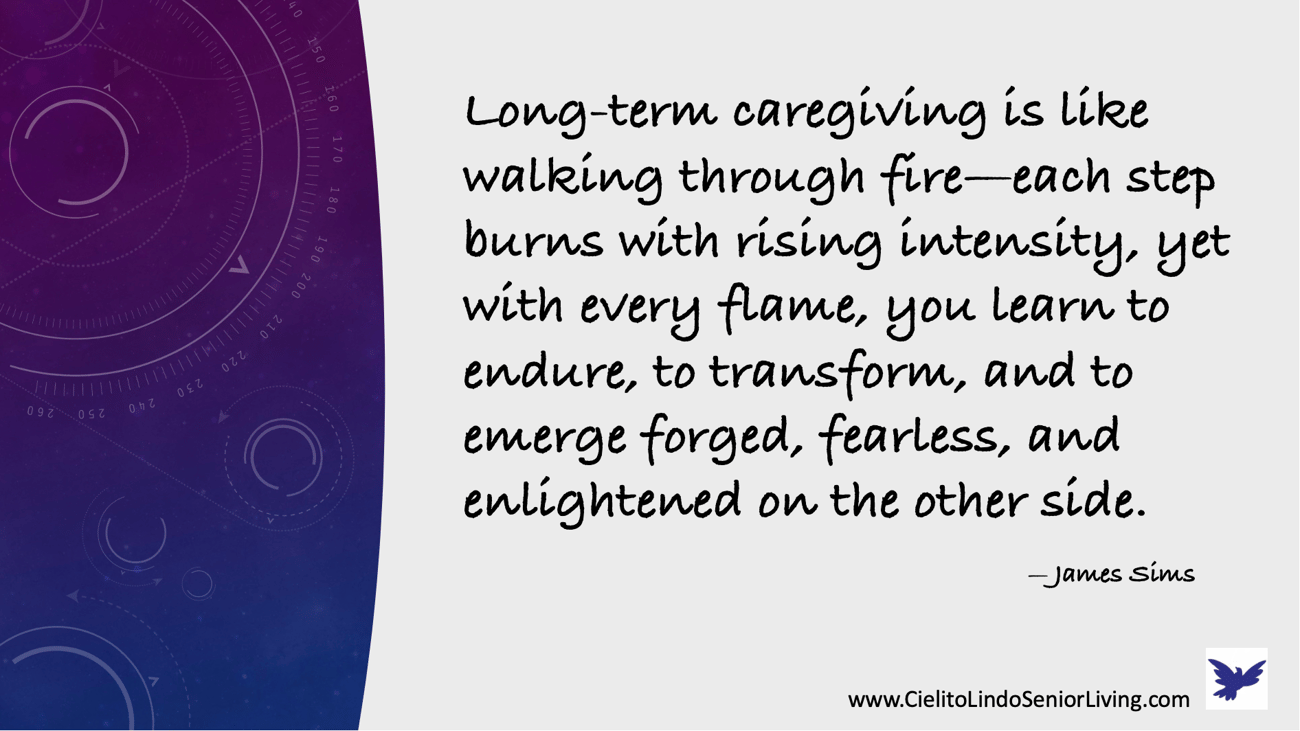
"Long-term caregiving is like walking through fire—each step burns with rising intensity, yet with every flame, you learn to endure, to transform, and to emerge forged, fearless, and enlightened on the other side.”
To the caregivers walking this path: this quote is for you. It speaks to the unspoken truth of your journey—the relentless demands, the emotional toll, the quiet courage it takes to show up every day. Caregiving isn't just about tending to another's needs; it's about enduring the heat of uncertainty, fatigue, and heartache, all while continuing to give love when your own cup feels empty. Each moment of sacrifice and each tear shed in silence is a step through the fire.
But with every step, something extraordinary happens. You change. You grow stronger, not because you wanted to, but because you had to. The fire doesn't just burn—it forges. It brings forth an inner resilience and compassion that only those who’ve been through it can truly understand. You emerge not only braver, but wiser, more tender, more human. This quote honors your transformation. It sees you, and reminds you: you are not alone, and you are profoundly heroic.
|
|
|
|
|
Digital Disconnect: Why Telemedicine Must Evolve to Truly Serve Our Elders
June 25, 2025 | James Sims, Editor, www.cielitolindoseniorliving.com
In a healthcare era racing toward digital transformation, one group is being inadvertently left behind: our elders. Though older adults use healthcare services more than any other age group, telemedicine often fails to meet their specific needs. It's a tragic irony—and one we must urgently address.
To ensure equitable healthcare, telemedicine must be redesigned with the elderly at its center. Not only are seniors the most frequent users of medical services, but they also stand to benefit immensely from the convenience and continuity that telehealth can offer—if only the system were built
with them in mind.
The Promise and Pitfalls of Telemedicine for Seniors
Telemedicine offers remarkable potential for older adults: eliminating long commutes, improving access to specialists, and enabling regular check-ins for chronic conditions. But the very technologies enabling these advantages can also act as barriers. Most platforms are designed for digital natives—those with quick reflexes, strong eyesight, and an instinctive ease with new interfaces.
Only 26% of Americans over 75 use smartphones daily, according to Pew Research. Navigating a telehealth portal with dropdown menus, small fonts, or multi-step logins can feel like trying to decipher a foreign language. For Bob, 84, the inability to log into his provider’s system meant three missed appointments and a worsening of his heart
condition. His story is all too common.
Cognitive and Cultural Gaps Widen the Divide
Access alone is not enough. Even when older adults connect successfully, meaningful communication can break down. Mild cognitive decline can impair memory and processing, making it difficult to absorb instructions or recall symptoms accurately. Add to this cultural norms—particularly among older generations who were taught not to question authority—and self-advocacy can become a steep uphill climb.
Healthcare providers, meanwhile, may speak quickly, rely on jargon, or fail to confirm understanding. In a rushed video call, one missed facial expression or unspoken concern can lead to an oversight that, for a frail patient, becomes a hospital visit.
The Case for Hybrid Care and Human Support
The solution isn’t to abandon telemedicine—it’s to enrich it. A hybrid model, combining virtual visits with scheduled in-person care, strikes a necessary balance. For stable conditions, remote monitoring makes sense. But for complex or nuanced cases, face-to-face interaction remains irreplaceable.
Crucially, this model must include real-time tech support and personalized assistance. Health systems like Kaiser Permanente illustrate what’s possible with integrated records and coordinated care. But even they stumble without “digital navigators”—staff who can help seniors and their caregivers manage portals, troubleshoot devices, and prepare for appointments.
Policy and Design
Solutions We Can Implement Now
Telemedicine platforms must evolve—immediately and inclusively. That means larger fonts, simpler interfaces, voice-activated commands, and live support during visits. Healthcare providers must receive training not just in geriatrics, but in virtual bedside manner: slow down, speak plainly, and verify comprehension.
On the policy front, Medicare and Medicaid need to expand support to cover the hidden infrastructure of successful telemedicine—tech literacy training, caregiver involvement, and hybrid models that include both virtual and in-person care. Just as we require ramps and railings in physical buildings, digital healthcare tools should be governed by usability standards that make them accessible to all.
Anticipating the Counterarguments
Some will argue that the digital divide is temporary—that today’s tech-savvy middle-aged adults will navigate telemedicine with ease when they become seniors. But aging changes more than habits; it affects cognition, coordination, and senses. Even the most tech-literate 50-year-old today will need accessible systems at 80. We can’t wait 30 years to make telehealth elder-friendly.
Conclusion: Aging in a Digital World Shouldn’t Mean Being Left Behind
We cannot retrofit elder care into systems designed for the young. If we want telemedicine to deliver on its promise, it must start with aging in mind. That means designing for usability, training for empathy, and legislating for equity.
In doing so, we not only improve care for millions of older Americans today—we affirm a shared commitment to
dignity, access, and inclusion for all of us tomorrow.
After all, the healthcare system we build for our elders is the one we’re building for our future selves. Let’s make it one worth inheriting.
|
|
|
|
|
As Telemedicine Grows, Problems Follow — But So Can Solutions
Telemedicine is no longer a stopgap—it’s a permanent fixture in modern healthcare.
Accelerated by the pandemic and now widely embraced across the healthcare system, virtual care offers convenience, continuity, and expanded access. But as telemedicine becomes the new normal, it risks leaving behind one of our most vulnerable populations: older adults. Over 13 million seniors face barriers to using telehealth effectively, from technological challenges and disabilities to social isolation and economic hardship. To truly fulfill the promise of telemedicine, we must design it with seniors in mind—simplifying platforms, improving digital literacy, and integrating tools like home visits and accessible devices into care plans. The question isn’t whether telemedicine will stay—it’s how we make it work for everyone, especially those who need it most.
Video: As Telemedicine Grows, Problems Follow
The video discusses the rise of telemedicine during the pandemic and highlights the challenges faced by older adults in accessing these services. While telemedicine has expanded access to healthcare, a significant portion of older adults—over 13 million—struggles with technology, leading to a disconnect in care. Factors such as social isolation, disabilities, and socioeconomic status exacerbate these challenges. Experts emphasize the need for more research and solutions, including treating digital devices as medical necessities and considering home visits to ensure equitable healthcare access for all, particularly vulnerable populations.
View the video here.
Highlights:
0:00 – The pandemic has boosted the use of telemedicine.
0:19 – Medicare patients can now visit any doctor by phone or video conference at no additional cost.
0:35 – Telemedicine offers opportunities for doctors and patients to connect regularly.
0:52 – A study found that 13 million older adults struggle to access telemedicine.
1:17 – More than a third of Medicare beneficiaries are not ready for video visits.
1:30 – Social isolation among older adults complicates access to telemedicine.
1:40 – Lower income men of color with poor health face the greatest challenges.
1:48 – There are significant issues with elderly care that require more research.
2:03 – Solutions include covering digital devices as medical necessities.
2:14 – Home visits may be essential for effective healthcare delivery.
|
|
|
|
|
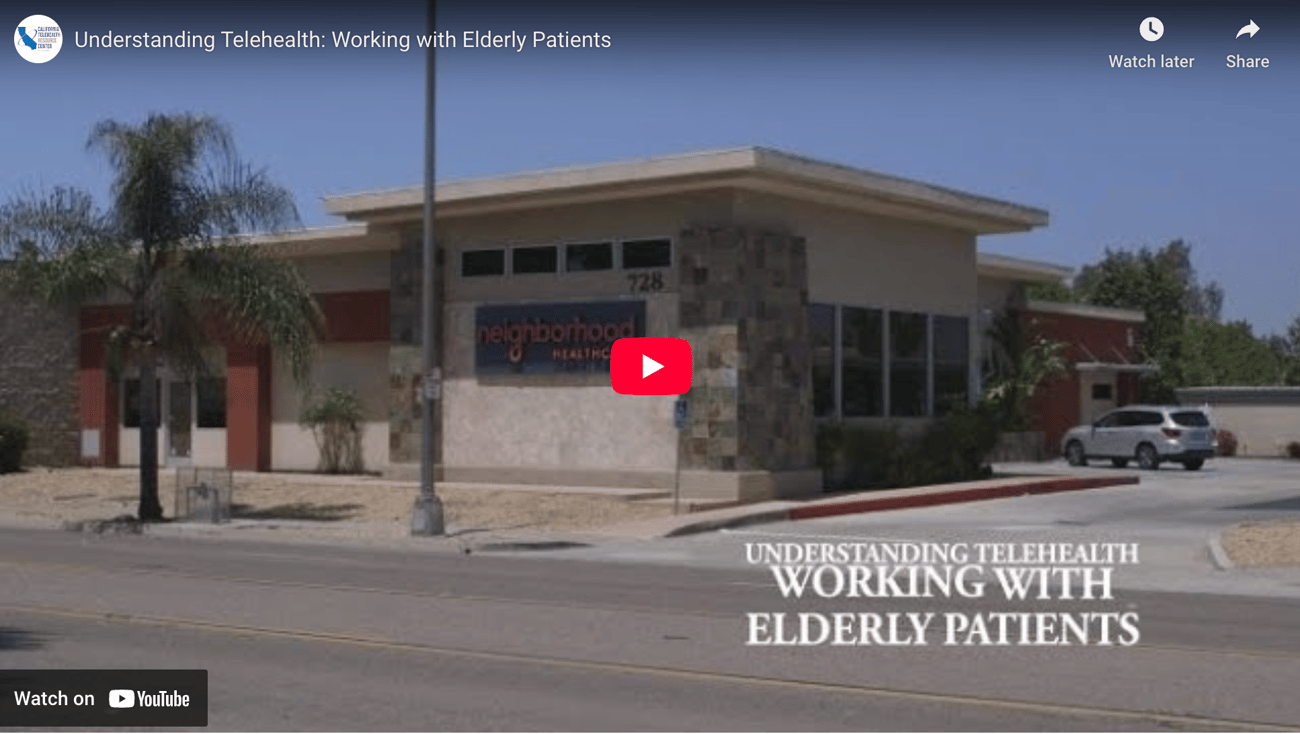
Telehealth for Seniors: Bridging the Gap with Compassion and Clarity
As telehealth becomes an increasingly common mode of care, one crucial question remains: how do we ensure that older adults aren’t left behind in this digital transformation? In this candid and insightful video, psychologist Heidi Miller Brunetto shares her journey adapting
to telehealth, especially when working with elderly patients. What emerges is a portrait not of resistance, but of resilience—where small adjustments in communication, technology support, and caregiver involvement can make a profound difference. For many seniors, hesitation about telehealth stems not from disinterest, but from unfamiliarity. With patience, education, and empathy, telehealth can become not just an alternative to in-person visits, but a source of real comfort and connection. The future of virtual care is here—and with the right approach, it can be just as personal as a handshake across a desk.
Understanding Telehealth: Working with Elderly Patients
In this video, psychologist Heidi Miller Brunetto discusses her experiences with telehealth, particularly with elderly patients. She initially faced anxiety about providing care through video and phone sessions but grew more comfortable over time. Key strategies include educating patients on technology, adjusting communication styles, and utilizing resources like headphones to enhance clarity. Telehealth offers significant advantages, such as convenience for patients with transportation issues and the ability to involve caregivers in sessions. Brunetto emphasizes that elderly patients may be hesitant rather than disinterested in telehealth, and she shares positive feedback from patients who appreciate the comfort and accessibility of
remote care.
Highlights:0:10 – Heidi Miller Brunetto introduces herself as a psychologist working with elderly patients.0:14 – She shares her initial reservations about using telehealth for patient care.1:07 – Emphasizes the importance of educating elderly patients on using technology for telehealth.1:45 – Suggests using headphones to minimize background noise during sessions.2:01 – Discusses the need to adjust communication style for better understanding.2:32 – Highlights the convenience of telehealth for elderly patients lacking transportation.2:50 – Notes the benefit of involving caregivers or family members during telehealth sessions.3:21 – Addresses the myth that elderly patients are disinterested in telehealth
services.3:39 – Shares positive feedback from patients feeling comfortable and understood through telehealth.4:04 – Concludes that telehealth can provide benefits comparable to in-person visits.
|
|
|
|
|
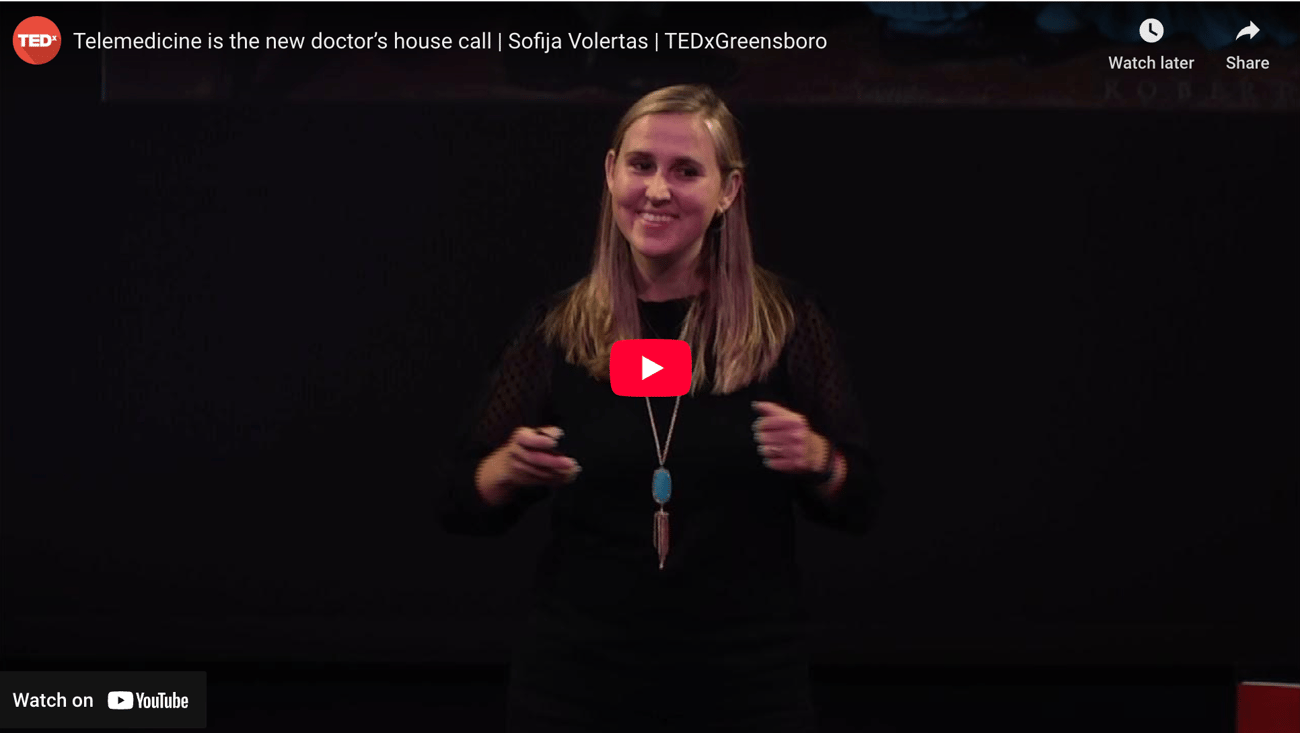
Telemedicine: The New House Call with a Human Touch
In a world reshaped by the pandemic, telemedicine has rapidly moved from the margins to the mainstream, transforming not just how care is delivered, but how it’s experienced. In her compelling TEDx talk, Dr. Sofija Volertas reframes telemedicine as more than a technological shift—it’s a revival of deeply personal, patient-centered care. From her own story of navigating pregnancy with virtual visits to data showing improved outcomes and lower costs, Volertas shows that telemedicine can be both efficient and profoundly human. When used with intention, it
allows providers to listen more deeply, understand patients in their environments, and build real connection across digital lines. As this new “house call” takes root, the future of medicine may lie not in more technology, but in better conversations—where healing begins by seeing the whole person, even through a screen.
Telemedicine is the new doctor’s house call | Sofija Volertas | TEDxGreensboro
In her TEDx talk, Sofija Volertas discusses
the transformative impact of telemedicine, particularly during the pandemic. Initially, she recounts her personal experience transitioning to telehealth, which has grown from 8% usage in 2019 to over two-thirds of Americans today. Telemedicine encompasses various healthcare areas, enhancing human connection and providing tailored care. Volertas highlights the convenience of telemedicine, sharing her experience during pregnancy, and emphasizes the efficiency it offers by reducing time and costs associated with traditional healthcare visits. A study she references demonstrates that telemedicine can lead to better health outcomes, such as improved blood pressure control and significant cost savings for patients.
In her talk, Sofija Volertas emphasizes that telemedicine is not just about
technology; it’s about fostering human connections and improving patient care. By focusing on listening and understanding patients’ environments, healthcare providers can enhance treatment outcomes and patient satisfaction. As telemedicine evolves, it is crucial for doctors to refine their communication skills and embrace the unique opportunities this approach offers for personalized care.
View the video here.
Highlights:
0:19 – The speaker shares her experience driving on an empty highway during the pandemic lockdown.
1:06 – Introduction to telemedicine as a practice of delivering care using technology.
1:39 – A significant increase in telehealth usage from 8% in 2019 to over two-thirds of Americans during the pandemic.
2:11 – Telemedicine is now integrated into various healthcare aspects, including primary care and robotic surgeries.
3:08 – Emphasis on human connection as
a crucial element of healing in telemedicine.
3:35 – Introduction of digitally enabled care as a combination of in-person and virtual healthcare.
4:05 – Rapid expansion of technology in telemedicine, including diagnostic attachments for smartphones.
5:20 – Personal anecdote about using telemedicine during pregnancy, highlighting convenience.
6:00 – Discussion on the average time spent in healthcare visits and the potential savings with telemedicine.
7:39 – A study showing improved blood pressure control and cost savings for
patients using telemedicine.
8:27 – Technology is rapidly improving the personalization of medicine through telemedicine.
8:41 – Dr. L’s experience shows that stepping back can enhance listening during patient assessments.
10:13 – Humanism in medicine emphasizes the importance of personal connection over data and technology.
10:54 – Many patients feel unheard during traditional visits due to doctors focusing on screens.
12:14 – Studies show that doctors who listen and empathize lead to better patient
outcomes.
12:59 – Telemedicine allows doctors to focus on personal stories rather than just physical exams.
13:20 – Telemedicine enables doctors to connect with patients in their home environment.
14:07 – Video visits can reveal environmental triggers affecting patients’ health.
15:00 – Doctors must improve communication skills to maximize telemedicine’s benefits.
16:38 – Telemedicine enhances human connection, allowing for more personal interactions despite being virtual.
|
|
|
|
|
Digital Health Through a Caregiver’s Lens
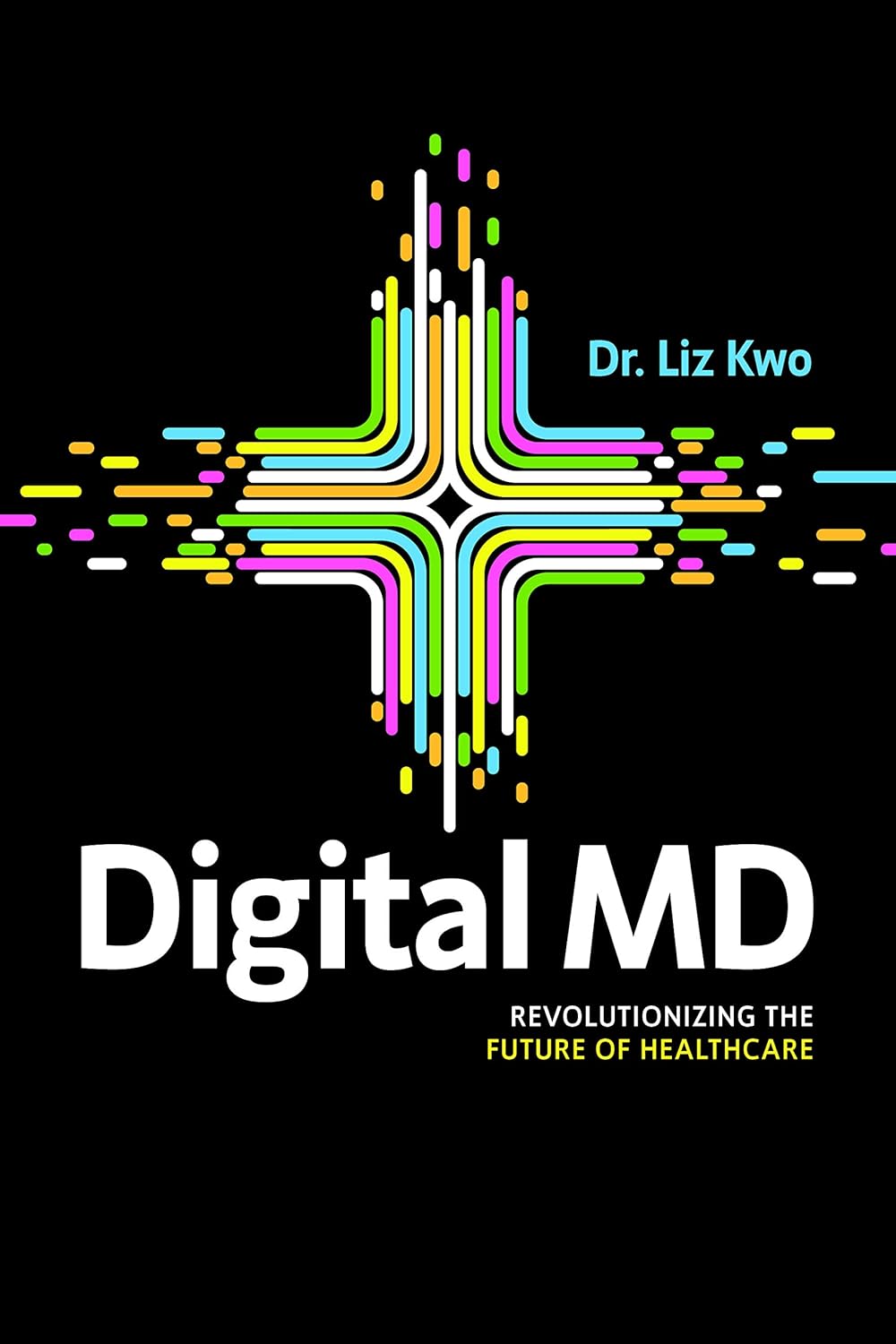
As the healthcare landscape rapidly evolves, caregivers face the growing challenge—and opportunity—of navigating digital tools that promise to enhance patient care, especially for older adults. Digital MD: Revolutionizing the Future of Healthcare by Dr. Liz Kwo offers an invaluable insider’s view into this transformation. For caregivers supporting seniors or those managing chronic
conditions, this book provides more than just a big-picture perspective—it delivers practical insight into how digital health innovations like telemedicine, remote monitoring, and data-driven tools can directly improve care delivery and patient empowerment. Whether you're coordinating appointments, advocating for access, or simply trying to understand what’s next, Dr. Kwo’s guidance can help you better support your loved ones in this new era of medicine.
Book Review: Digital MD: Revolutionizing the Future of Healthcare by Liz Kwo, MD,
MBA, MPHPublished: June 11, 2024
Overview
In Digital MD, Dr. Liz Kwo—a Harvard-trained physician and serial healthcare entrepreneur—provides a rare, insider’s view into the forces shaping the current digital health revolution. With a unique combination of clinical, corporate, and public-sector experience, Dr. Kwo guides readers through the often
opaque world of healthcare transformation. This book is especially valuable for those involved in healthcare leadership, innovation, or policy—and highly relevant for seniors, caregivers, and retirees interested in how digital health is evolving and impacting their care options.
Synopsis
Drawing on decades of hands-on experience, Digital MD explains how digital tools and technologies—like telemedicine, AI diagnostics, remote monitoring, and healthcare analytics—are reshaping the industry. Dr. Kwo demystifies how healthcare organizations operate, how partnerships are formed, and how digital
health solutions are funded and scaled. Each chapter offers real-world examples, case studies, and lessons that bridge the gap between policy, patient care, and innovation. This book is more than just a roadmap for digital health entrepreneurs; it is a manifesto for transforming the healthcare experience for patients and providers alike.
Key Themes
- The Rise of Digital Health: Explores how COVID-19 and policy shifts accelerated digital transformation.
- System Complexity: Unpacks the intricate interactions between providers, payers, employers, and government agencies.
- Access & Equity: Emphasizes technology’s potential to increase access for underserved populations, including seniors and rural communities.
- Innovation in Aging: Offers insight into how digital health can address chronic disease management, telehealth for older adults, and home-based care.
- Reimbursement & Regulation: Clarifies the financial and legal realities of deploying new
healthcare technologies.
- Caregiver and Patient Empowerment: Shows how data, devices, and apps are giving more control to patients and their families.
Writing StyleDr. Kwo’s writing is accessible, clear, and engaging despite the technical nature of the content. She avoids jargon when possible and supplements more complex discussions with illustrative case studies and analogies. Her tone is professional yet optimistic, encouraging innovation while acknowledging real-world challenges. The book flows logically, making it easy for readers without a business or medical background to follow.
Conclusion
Digital MD is an essential read for anyone seeking to understand or influence the future of healthcare, especially as it pertains to aging populations and long-term care. Dr. Kwo’s balanced, thoughtful perspective helps readers—from policymakers to caregivers—navigate a confusing landscape of rapid
technological change. Seniors and those involved in their care will find valuable insight into how digital health tools can enhance autonomy, improve outcomes, and reduce costs.
Rating: ★★★★★ (5 out of 5 stars)A compelling, timely, and deeply informed guide to the evolving world of healthcare innovation.
Additional Resources Cielito Lindo Offers
We have curated collections of resources that may be useful.
Articles - We write fresh articles about senior living, health, care, and finances every week
Caregiver Books - We review books related to caregiving methods, logistics, challenges, and coping
Senior Health - We review books related to healthspan, lifespan, and disease
We also have 1,600+ other senior care and expat in Mexico videos: YouTube |
|
|
|
|
| Cielito Lindo's basic information is included for your convenience:
|
|
|
- Cielito Lindo Info: After the signature, the newsletter always includes information about Cielito Lindo, so it is at your fingertips when you want it: Our costs, various related websites, social media channels like YouTube, our various addresses, and so on.
- Travel Info: Recommended airports and shuttles.
|
|
|
Web Sites - Cielito LIndo and Rancho Los Labradores
Here are our Web sites, including Cielito Lindo and Labradores Suites (hotel) all of which are part of the larger Rancho Los Labradores gated community just north of San Miguel de Allende.
- Cielito Lindo provides independent living, light assisted living, assisted living, memory care and hospice with 24*7 staffing along with a la carte assisted living services to those living in the villas and suites at Rancho Los Labradores.
- Rancho Los Labradores Suites offer short and long term residence.
- Rancho Los Labradores is a country club resort feeling CCRC that provides a gated community with countless amenities and opportunities for different levels of independent living along with assisted living and memory care within Cielito Lindo.
Cielito Lindo Living Options & Costs Guide
We offer several living options depending on the level of care you or your loved one needs. Here’s a breakdown to help you plan:
1) Villas (Rent or Own)
- Cost: $1,300 – $1,700 per month
- Additional Costs: Utilities, renter’s insurance, etc.
- What’s Included: This is mostly independent living.
- Extras: You can add independent or assisted living services (charged separately, à la carte).
- Support: We can connect you with a realtor if you'd like to purchase.
2) Cielito Lindo Condos & Suites
Best for: Independent living with optional assistance.
Option 1: Independent Living + Meals
- Cost: $2,250 per month
Includes:- 2 meals a day
- Monthly medical check-up
Optional Add-ons:- Meals for an additional person: $450/month
- Extra care services available à la carte
Option 2: Light-Assisted Living in Condos & Suites
- Cost: $3,900 per month
Includes:- Full assisted living services
- Designed for residents who still want independence but need some support
- Smooth transition to full Assisted Living or Memory Care as needs
change
- One-Time Inscription Fee: $4,000
For Couples:- $4,900/month for two people
- Same one-time fee ($4,000 per couple)
- Note: Suitability is based on cognitive ability, mobility, and safety.
3) Cielito Lindo Assisted Living, Memory Care, & Hospice
Best for: Seniors needing full-time care and supervision.
- Cost: $3,900 per month
Includes:- 24/7 care and monitoring
- All meals
- Physical therapy
- Full-time doctor on site
- Spacious private room with
bath
- One-Time Inscription Fee: $4,000
- For Couples: $4,900/month
4) Specialized Hospice Suite
Best for: Intensive care needs or end-of-life comfort and also recuperative at a far lower cost than a hospital- Cost: $4,900 per month
Includes:- Full 24/7 monitoring
- Recuperative, Palliative and hospice care
- On-site doctor
- All meals
- Special space for visiting
family
|
|
|
YouTube videos and Curated Playlists
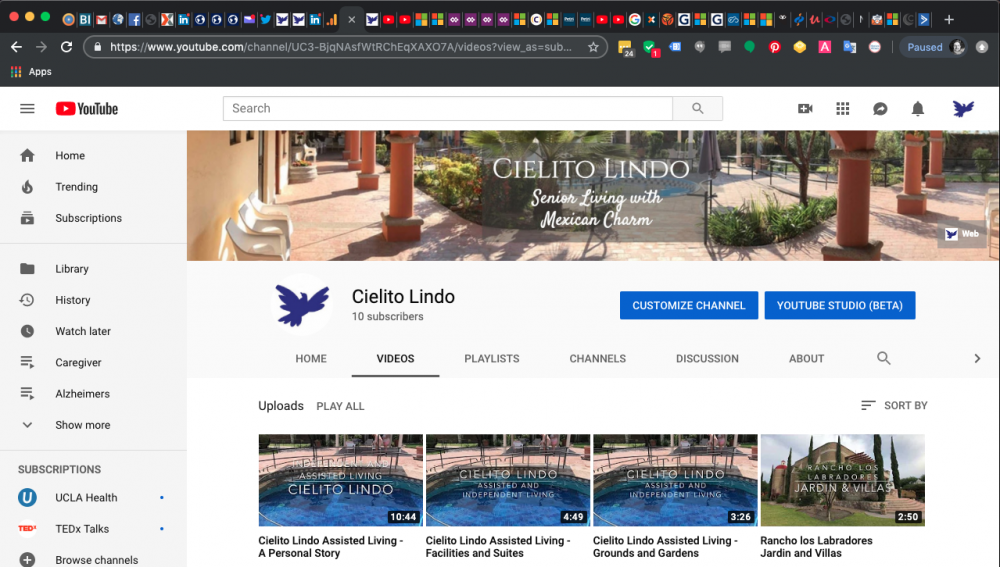
Here is our YouTube Channel. This is where we have lots of videos about Cielito Lindo and Rancho Los Labradores. We also have 1,600+ other senior care and expat in Mexico videos: YouTube |
|
|
|
|
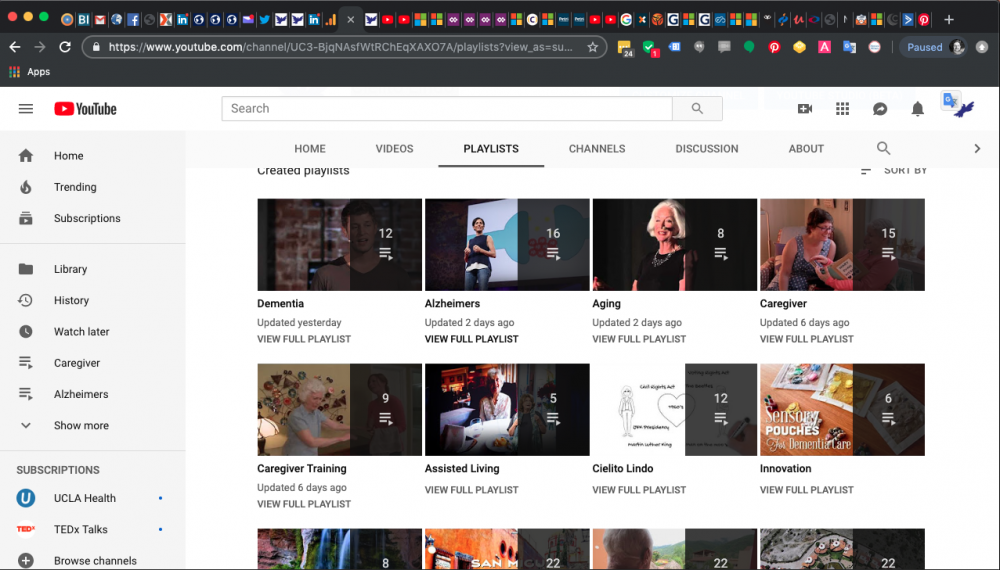
Additionally, our playlists cover a wide area and include 1,200+ videos. These playlists include videos about San Miguel and Mexico in general, caregiving and health, and a broad spectrum of senior living topics. Playlists
|
|
|
|
|
Additional Resources We Offer
We have curated collections of resources that may be useful:
Articles - We write fresh articles about senior living, health, care, and finances every week
Caregiver
Books - We review books related to caregiving methods, logistics, challenges, and coping
Senior Health - We review books related to healthspan, lifespan, and disease
And here are our various social media forums, where we talk a lot about assisted living and memory care along with the various sort of challenges that sometimes come in our senior years (Alzheimer’s, Parkinson other dementias, and so on), but also about senior living in Mexico.
Facebook
|
|
|
|
|
|
|
|
|
|
|
|
|
|
|
|
|
|
|
Please don’t hesitate to contact me for anything related to senior living, especially in Mexico. I will gladly give you any assistance I can.
Thanks again!
James
James Sims
Marketing and Sales
Cielito Lindo Senior Living
1. 888.406.7990 (voice and text)
Phones:
English speaking:
1.888.406.7990 (in US & CDN)
00.1.881.406.7990 (in MX)
Spanish speaking:
011.52.415.101.0201 (in US & CDN)
1.415.101.0201 (in MX)
Expat Logistics:
Visas for Expats:
Sonia Diaz Mexico
Immigration
Pros MX
Tax Considerations for Expats:
Robert Hall Taxes
Best Bank:
Intercam Banco
Located in: Plaza De La Conspiración
Address: San Francisco 4, Zona Centro,
37700 San Miguel de Allende, Gto., Mexico
Hours: Open ⋅ Closes 4 PM
Phone: +52 415 154 6660
Addresses and Travel:
Physical address:
Cielito Lindo Independent and Assisted Living, Camino Real Los Labradores S/N, Rancho Viejo 1, San Miguel de Allende, GTO, Mexico, 37885
Packages from online providers like Amazon:
Camino Real Los Labradores, Rancho Los Labradores / Cielito Lindo, San Miguel de Allende, GTO, 37880 México
PO Box for letters and small envelopes:
Rancho Los Labradores / Cielito Lindo, c/o Alejandra Serrano ,
PMB N° 515-C, 220 N Zapata HWY N°11, Laredo TX, 78043-4464
Best airports to fly into: Leon (BJX) or Queretaro (QRO)
Best airport shuttle: BajioGo
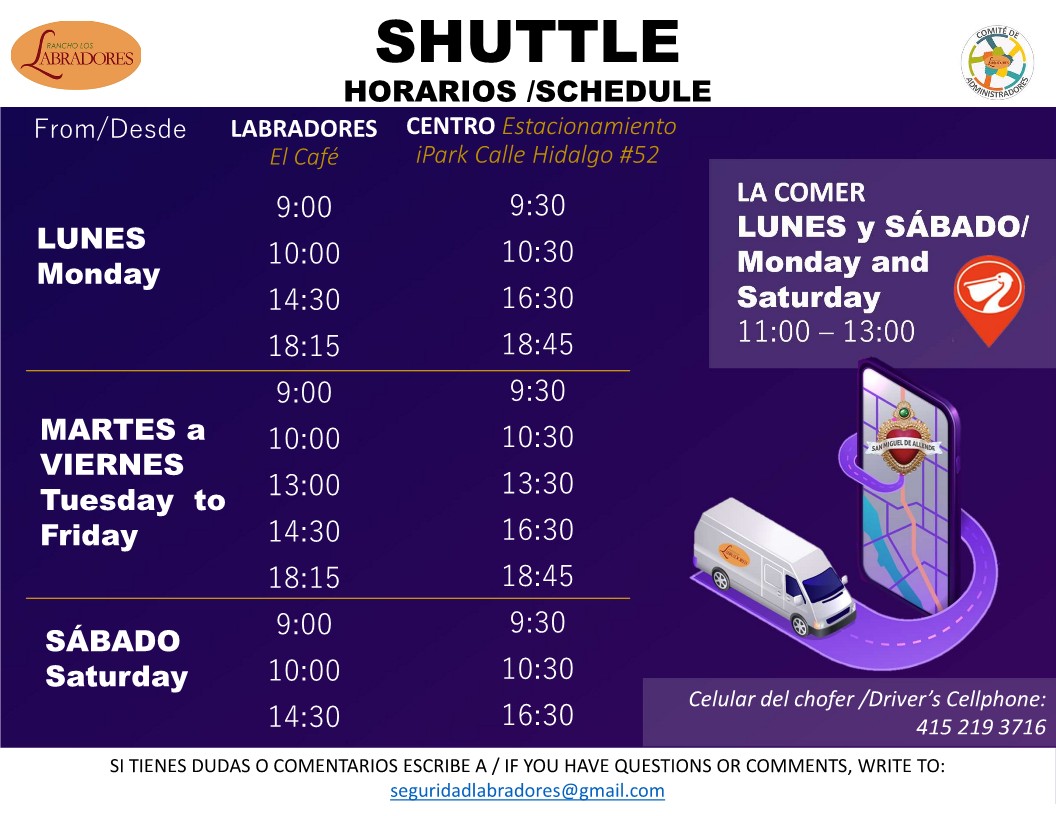
Shuttle:
Shuttle between San Miguel and Cielito Lindo
|
|
|
|
|
|
Maps and Navigation
Best smartphone navigation for Mexico and Central America: Waze
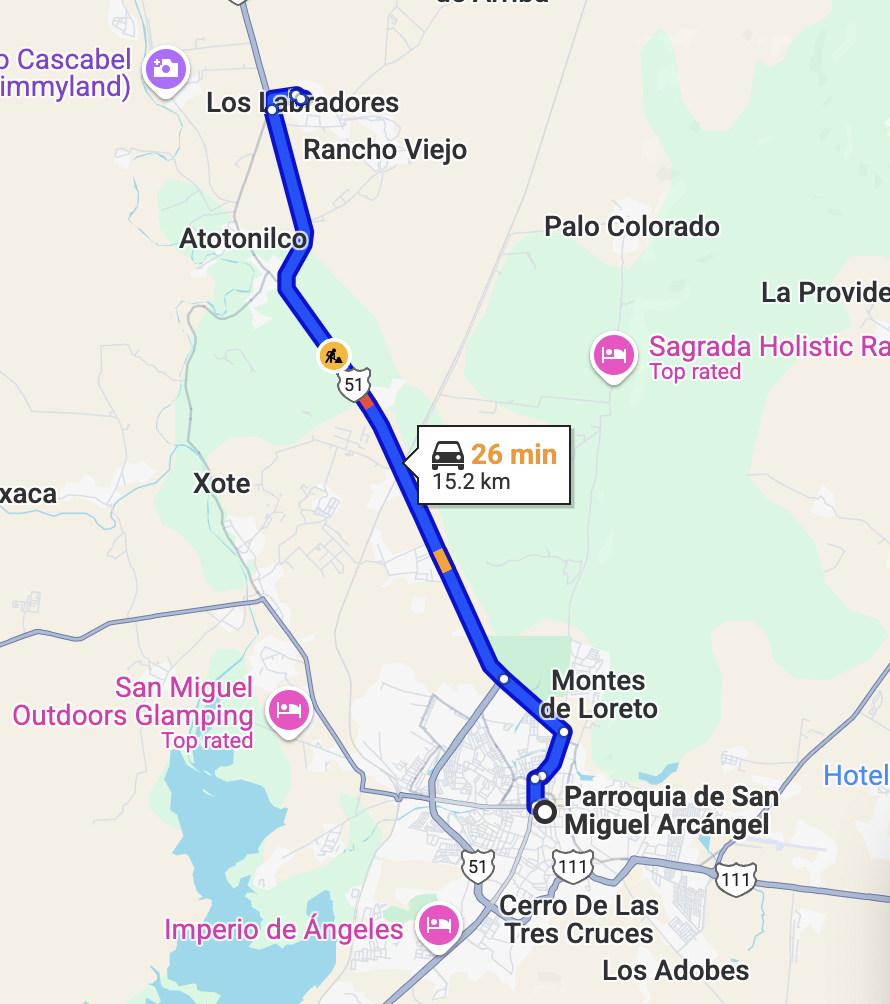
These two maps the location of Cielito Lindo / Rancho Los Labradores, 15 km north of San Miguel on Highway 51, just opposite the Atoltinilco exit.
|
|
|
|
|
|
|
Regards,
James
James Sims
Marketing and Sales
Cielto Lindo Senior Living
James@CielitoLindoSeniorLiving.Com
|
|
|
|
|
|
|
|